Restaurants should post social media content that gives people a specific reason to visit, order, reserve, or come back.
That means your content should focus on food people crave, experiences they want to be part of, events with a reason to act now, real people inside the restaurant, social proof from actual guests, and clear calls to action.
Posting beautiful food pictures is not enough.
Getting thousands of Reel views is not enough.
Growing your follower count is not enough.
Clicks do not pay your bills. Covers do.
The job of restaurant social media is not simply to entertain people. It should help move someone from scrolling on their phone to walking through your door.
What Type of Social Media Content Actually Brings Customers Into a Restaurant?
The restaurant content most likely to influence a visit usually falls into seven categories:
- Food and drinks people can picture themselves ordering
- Experiences people want to be part of
- Promotions tied to a specific day or need
- Events that create urgency
- Real guests and social proof
- Chefs, bartenders, servers, and restaurant personalities
- Content with a clear next step
The best restaurant social media strategies combine several of these instead of posting random food photos every day.
The bigger question should always be:
What do we want the customer to do after seeing this post?
If you cannot answer that question, the content probably needs more strategy behind it.
1. Post Food People Can Picture Themselves Ordering
Yes, restaurants should post food.
But there is a huge difference between showing food and selling the desire to experience it.
A picture of a burger with the caption “Come try our delicious burger” does very little.
Instead, give the customer context.
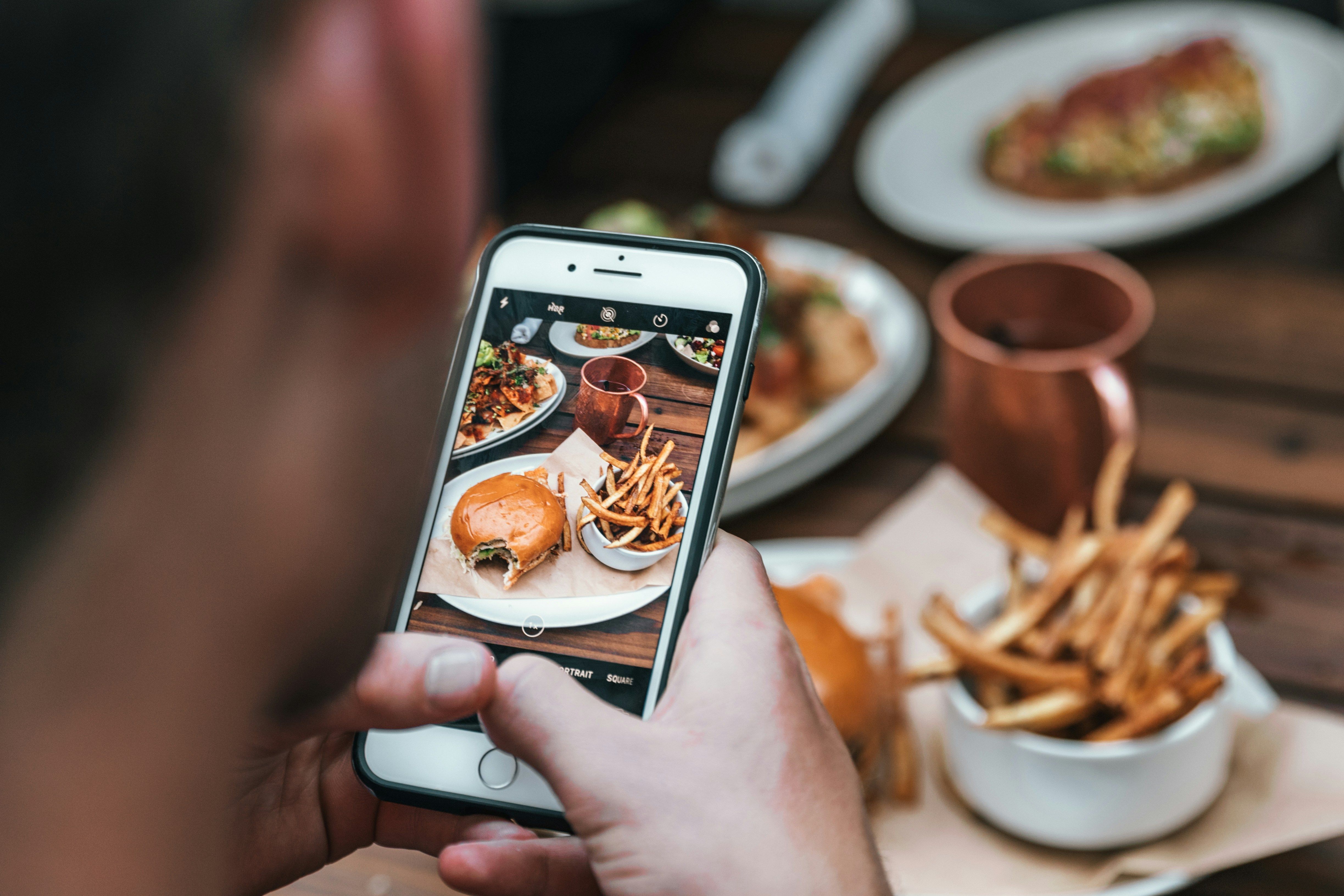
Show the burger being cut open.
Show the cheese melting.
Show the bartender pouring the cocktail next to it.
Show two people sharing appetizers during happy hour.
Show your chef explaining why that dish made the new fall menu.
The food is still the star. But now there is a reason to care.
Better restaurant food content could include:
- A chef finishing a signature entrée
- A bartender building a seasonal cocktail
- A server dropping a sizzling dish onto the table
- A close up of a new menu item
- A guest tasting something for the first time
- A behind the scenes look at how a popular dish is made
- A quick video explaining what makes one menu item different
One thing we see constantly at Brand To Table is restaurants treating their social feeds like digital menus.
Photo.
Dish name.
A few hashtags.
Next post.
That is not a strategy.
Stop selling the plate by itself. Sell the moment around the plate.
2. Show Customers What It Feels Like to Be There
People do not choose restaurants based only on food.
They choose restaurants based on occasions.
Date night.
Sunday brunch.
Watching football with friends.
Dinner with the family.
Girls night.
Happy hour after work.
A birthday.
A business lunch.
An anniversary.
Your social media should help potential customers picture themselves having those experiences inside your restaurant.
For example, a restaurant trying to grow Sunday brunch should not only post pancakes.
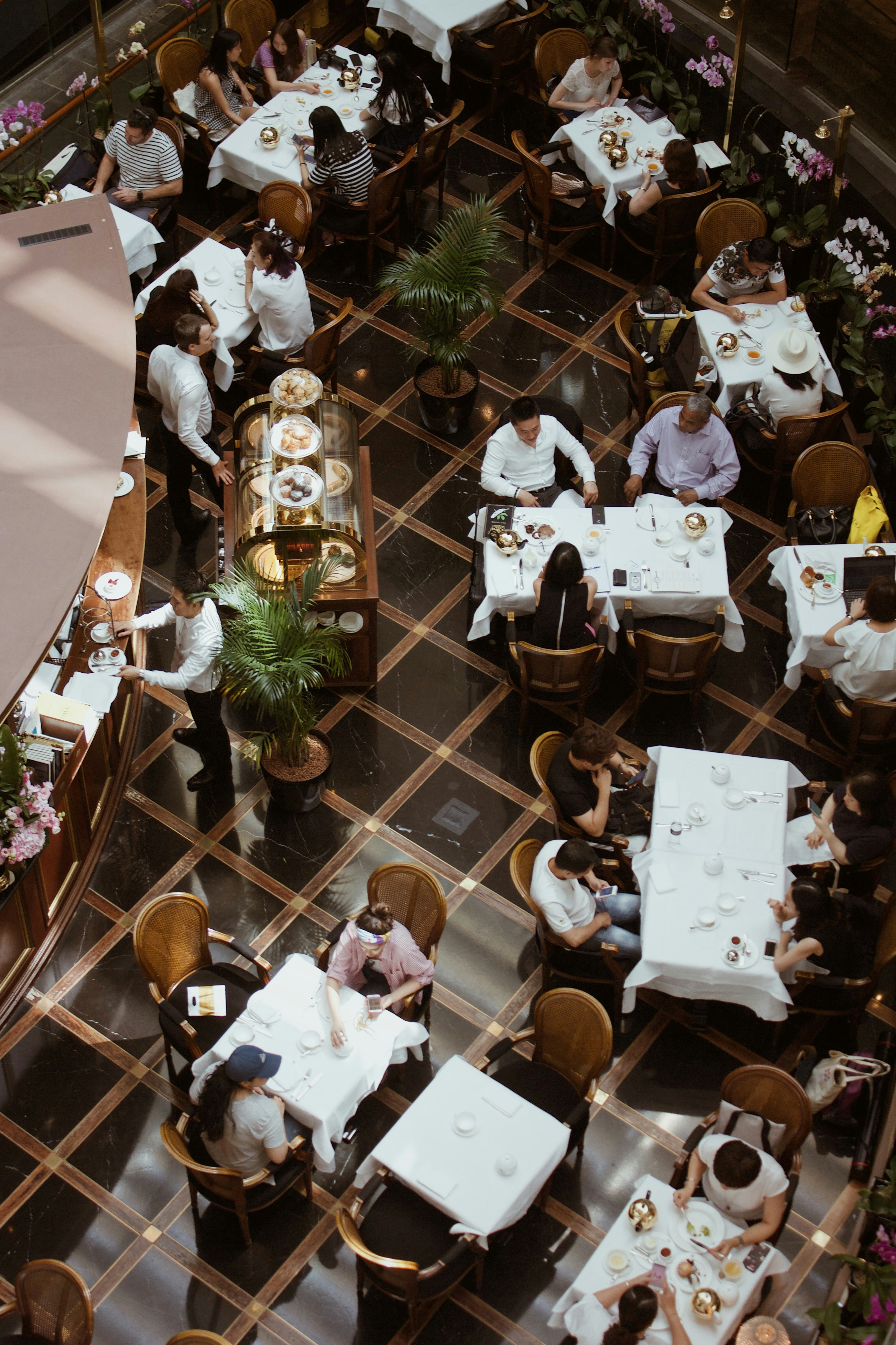
Show the room full of people.
Show Bloody Marys arriving at the table.
Show friends laughing.
Show the brunch spread.
Show the lake view, rooftop, patio, bar, fireplace, live music, or whatever makes that experience different.
A customer should be able to watch your content and think:
“That looks like where we should go Sunday.”
That is much more powerful than telling them your pancakes are delicious.
3. Build Content Around the Traffic Problems You Need to Solve
This is where restaurant social media becomes marketing instead of content creation.
Before deciding what to post, look at the business.
Where are you slow?
Monday night?
Tuesday dinner?
Late afternoon?
Lunch?
Sunday evening?
Are private events underbooked?
Is brunch new?
Are people ignoring your loyalty program?
Is online ordering growing slower than you expected?
Those problems should influence your content calendar.
At Brand To Table, we do not start by asking:
“What should we post this week?”
We start by asking:
“What does the restaurant need help selling this week?”
That small shift changes everything.
If Wednesday is struggling, you may need several pieces of content supporting Wednesday over the course of the month.
One post is rarely enough.
Customers need repetition.
They need to see Wednesday night trivia.
Then the wing special.
Then people actually playing trivia.
Then a Reel showing the atmosphere.
Then a Story reminding them Wednesday afternoon.
You are building familiarity around the occasion.
Match the business problem to the content.
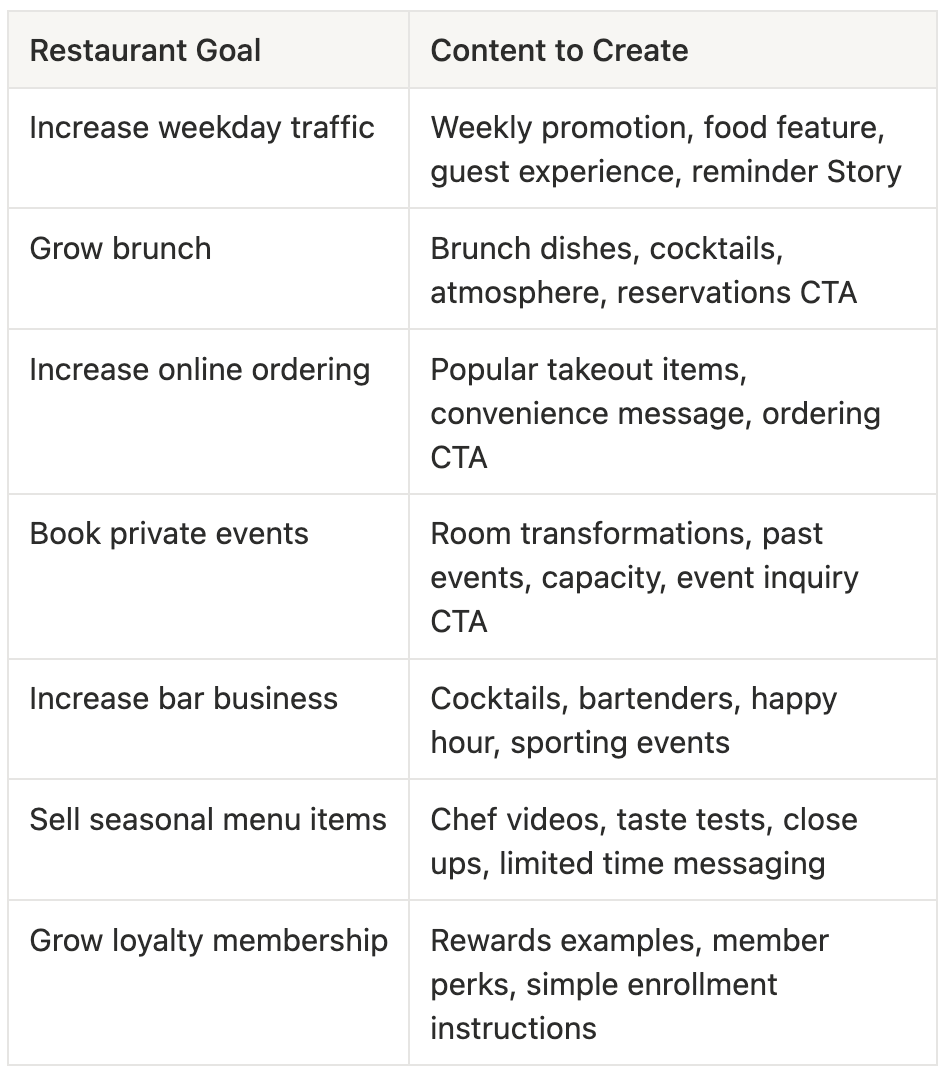
Your content calendar should follow the needs of the restaurant, not whatever happens to be sitting in your camera roll.
4. Promote Offers Without Training Customers to Wait for Discounts
Promotions can drive traffic.
But there is a difference between giving somebody a reason to visit and constantly discounting your product.
Restaurants should use social media to promote value without making price the only reason customers come.
For example:
Weak message:
“20% OFF TONIGHT!”
Stronger message:
“Tuesday martinis just became your excuse to get out of the house.”
Now you can introduce the offer.
The promotion supports the experience instead of becoming the entire brand.
Restaurants can create content around:
- Happy hour
- Weekly specials
- Prix fixe menus
- Taco Tuesday
- Wing night
- Wine night
- Football menus
- Brunch
- Live entertainment
- Trivia
- Music bingo
- Seasonal features
The important part is consistency.
If your restaurant has the same promotion every Wednesday, do not assume customers know about it because you posted it three weeks ago.
They probably do not.
Recurring promotions require recurring marketing.
Change the creative.
Change the hook.
Show different food.
Use different video.
Feature the crowd.
But keep reinforcing the same reason to visit.
5. Post Real People, Not Just Products
Restaurants are hospitality businesses.
Hospitality involves people.
Yet some restaurant social media accounts look like no human being has ever stepped inside the building.
Plate.
Plate.
Cocktail.
Plate.
Graphic.
Plate.
That gets old fast.
Show your people.
Your chef.
Your bartender.
Your servers.
Your managers.
Your regular customers when appropriate.
People create familiarity.
Familiarity creates trust.
Trust makes choosing your restaurant easier.
Some of the most useful restaurant content can be extremely simple.
Ask the chef:
“What is the one dish somebody has to try here?”
Ask the bartender:
“What drink are you making someone who tells you to surprise them?”
Ask a server:
“What do first time customers order the most?”
These videos do not need a Hollywood production crew.
They need personality.
The restaurant industry is full of characters.
Use them.
6. Use Social Proof to Remove the Risk of Trying Your Restaurant
Customers trust other customers.
That makes social proof one of the strongest forms of restaurant content.
Social proof includes:
- Customer reviews
- User generated videos
- Guest photos
- Influencer content
- Customer testimonials
- Sold out events
- Busy dining rooms
- Repeat customers
- Comments from happy guests
The goal is not to scream, “Look how amazing we are.”
The goal is to show potential guests that other people already enjoy being there.
For example, instead of designing another graphic telling customers that your brunch is popular, show a busy brunch service.
Instead of telling people your bartender makes great cocktails, show guests trying them.
Instead of claiming your private event space is perfect for parties, show an actual room transformation.
Proof is stronger than promotion.
7. Create Content Around Events Before the Event Is Almost Over
Restaurants frequently wait too long to market events.
They announce something a few days before it happens and then wonder why nobody shows up.
An event should normally become a small campaign.
You might start with:
Announcement content:
Tell people what is happening.
Experience content:
Show why it will be fun.
Reminder content:
Keep the event visible.
Urgency content:
Remind people that the date is getting close.
Day of content:
Give someone one last reason to come.
This works for:
- Wine dinners
- Halloween events
- Mother's Day
- Valentine's Day
- Football watch parties
- Live music
- Brunch events
- Tastings
- Holiday dinners
- Restaurant anniversaries
- Chef collaborations
Posting once is an announcement.
Marketing requires repetition.
8. Give Every Important Post a Clear Next Step
One of the easiest ways restaurants waste social media attention is by forgetting to tell people what to do next.
If someone is interested in your brunch, what should they do?
If they want tickets for the wine dinner, where do they go?
If they want to book a private event, what happens next?
If they see a great takeout dish, how do they order it?
Do not make customers work for the answer.
Useful restaurant calls to action include:
- Book your table
- Order online
- Join us tonight
- Make your reservation
- View the menu
- Call to reserve
- Send us a message
- Comment BRUNCH below
- Comment MENU below
- Join our rewards program
At Brand To Table, we have become especially interested in using social content together with direct message automations.
Instead of telling someone to “check the link in bio,” a restaurant can ask them to comment a specific word.
For example:
“Comment BRUNCH below and we will send you the reservation link.”
The customer raises their hand.
The restaurant creates engagement.
And there is a much shorter path between interest and action.
That is what restaurant marketing should do.
Remove friction.
What Should Restaurants Stop Posting?
Restaurants should stop relying on generic content that has no clear purpose.
That includes posts like:
- “Happy Friday!”
- “Come visit us!”
- Random food photos with no context
- Generic quote graphics
- National food holiday posts with no connection to the restaurant
- Repetitive Canva graphics
- Videos chasing trends that have nothing to do with the brand
- Posts created only because “we haven't posted today”
Not every post has to directly sell something.
But every post should have a job.
That job might be building familiarity.
Showing personality.
Creating desire.
Promoting an event.
Educating customers.
Generating reservations.
Getting people talking.
If the only reason you are publishing something is because your social media calendar says you need five posts this week, that is usually a sign the strategy is backwards.
How Often Should a Restaurant Post on Social Media?
Most restaurants should focus more on consistency and quality than chasing a perfect number of posts.
A practical restaurant content schedule might include:
- 3 to 5 feed posts or Reels per week
- Stories several times throughout the week
- Additional Stories around promotions, events, and busy service periods
- More frequent content when launching a new menu or major event
A restaurant does not automatically need to post three times per day.
You need enough content to stay visible without publishing garbage just to fill space.
For multi location restaurants, consistency becomes even more important.
Customers should recognize the brand across locations while still seeing enough local personality to make each restaurant feel real.
What Is a Good Weekly Restaurant Social Media Content Mix?
A restaurant trying to increase visits could use a weekly mix like this:
Monday:
Promote a weekday offer or reason to visit.
Tuesday:
Feature a signature food or drink item.
Wednesday:
Show the people behind the restaurant.
Thursday:
Promote the weekend experience.
Friday:
Post atmosphere, cocktails, guests, or a strong Reel.
Saturday:
Use Stories for real time social proof.
Sunday:
Promote brunch, family dining, football, or the upcoming week.
This is not a rule.
It is a starting point.
Your actual content mix should depend on your restaurant's revenue goals.
A steakhouse should not have the same content strategy as a sports bar.
A fast casual chicken concept should not copy the strategy of an upscale waterfront restaurant.
And a restaurant trying to build catering sales needs different content from a restaurant trying to fill Tuesday night tables.
Context matters.
Should Restaurants Focus More on Reels, Photos, or Stories?
Restaurants should use all three because each format has a different job.
Reels
Use Reels to generate discovery, personality, emotion, and reach.
Good Reel topics include:
- Food preparation
- Taste tests
- Chef explanations
- Restaurant atmosphere
- Before and after event setups
- Cocktails being made
- Customer reactions
- Behind the scenes moments
Photos and Carousels
Use photos and carousels when customers need to slow down and process information.
These are useful for:
- New menus
- Events
- Weekly promotions
- Catering
- Private dining
- Seasonal offers
- Multiple menu items
Stories
Stories are great for reminders and urgency.
Use Stories for:
- “Tonight”
- “Tomorrow”
- Available reservations
- Game times
- Live music reminders
- Behind the scenes clips
- Weekend brunch reminders
- Polls
- Questions
- User generated content
Restaurants should not choose one format and abandon everything else.
Each format plays a different role in moving customers toward a visit.
Restaurant Social Media Should Connect to Revenue
This is where many restaurant marketing conversations go sideways.
Somebody posts a Reel.
It gets 42,000 views.
Everybody gets excited.
Great.
What happened next?
Did website traffic increase?
Did people click the reservation link?
Did anyone comment asking for information?
Did online orders increase?
Did people join the email list?
Did the restaurant get more covers?
Views are useful.
Engagement is useful.
Follower growth is useful.
But those numbers are signals.
They are not the final goal.
At Brand To Table, we want social media connected to things restaurants can actually measure whenever possible.
That includes:
- Reservations
- Covers
- Online orders
- Email signups
- Loyalty signups
- Direct messages
- Event inquiries
- Catering leads
- Private party leads
- Revenue from specific promotions
You cannot always connect every Instagram Reel to a dollar.
Restaurant marketing does not work that neatly.
But you should understand what business outcome your content is trying to influence.
The Biggest Social Media Mistake Restaurants Make
The biggest mistake restaurants make on social media is creating content without connecting it to a business objective.
The restaurant hires somebody to post.
That person makes content.
Content gets published.
Everybody checks the box.
“Social media is handled.”
But what is the strategy?
What are we trying to sell?
Which day needs traffic?
Which offer needs awareness?
What customer are we trying to reach?
What should happen after they see the content?
Those questions matter more than whether you posted four times or six times this week.
Social media without strategy is just noise with a logo on it.
A Simple Restaurant Social Media Formula
When planning your next restaurant post, answer these four questions:
1. Who is this post for?
Families?
Couples?
Football fans?
Local professionals?
Brunch customers?
Regulars?
Event planners?
2. What are we selling?
Not just the food.
What experience, occasion, product, or offer are you selling?
3. Why should they care right now?
Is something new?
Is it only available this weekend?
Is Wednesday normally your slow night?
Is there a game happening?
Is Mother's Day approaching?
Give people context.
4. What should they do next?
Reserve.
Order.
Comment.
Call.
Visit.
Share.
Join.
Make the next step obvious.
That simple framework will improve most restaurant social media immediately.
Frequently Asked Questions About Restaurant Social Media
What should restaurants post on Instagram?
Restaurants should post food, drinks, guest experiences, employees, promotions, events, behind the scenes content, social proof, and clear reasons to visit. Instagram content should help customers picture themselves dining at the restaurant instead of simply showing menu items.
What restaurant posts get the most customers?
Content tied to a specific occasion or reason to visit is often more useful than generic brand content. Examples include weekend brunch, happy hour, events, seasonal menu launches, sports watch parties, limited time dishes, and restaurant experiences.
Should restaurants post every day?
Not necessarily. Restaurants should prioritize consistent, useful content over posting every day simply to stay active. Three to five strong weekly posts combined with regular Stories can be more effective than seven weak posts.
Should restaurants post mostly food photos?
No. Food should be an important part of restaurant social media, but restaurants should also show people, atmosphere, experiences, events, employees, guests, promotions, and behind the scenes moments.
Do Instagram Reels actually help restaurants?
Reels can help restaurants reach new people and showcase food, personality, and atmosphere. However, Reel views alone do not guarantee more customers. Restaurants should connect strong Reels to reservations, ordering, events, direct messages, or another measurable action whenever possible.
How can a restaurant turn social media followers into customers?
Give followers a clear reason to visit and make the next step easy. Promote specific experiences, use clear calls to action, link directly to reservations or online ordering, and use tools such as direct message automations to reduce the number of steps required to take action.
What should a restaurant post when business is slow?
Build content around the slow period itself. Promote a reason to visit on that specific day, such as happy hour, entertainment, a special menu, loyalty rewards, sports, or a recurring weekly experience. Do not wait until the restaurant is slow to begin marketing it.
How far in advance should restaurants promote events?
Major restaurant events should usually be treated as campaigns rather than single posts. Begin with an announcement, follow it with experience driven content and reminders, then increase urgency as the event gets closer.
How do multi location restaurants handle social media?
Multi location restaurants should keep the core brand consistent while allowing individual locations to show local personality. Promotions, menus, events, and customer behavior may vary by location, so content should reflect those differences instead of forcing every location to publish identical posts.
What social media metrics should restaurants track?
Restaurants should monitor reach and engagement, but they should also watch reservations, covers, online orders, website visits, direct messages, loyalty signups, email signups, catering leads, event inquiries, and other actions connected to revenue.
Your Restaurant Does Not Need More Random Content. It Needs Better Reasons to Visit.
The goal of restaurant social media is not to win Instagram.
The goal is to make your restaurant easier to remember, easier to choose, and easier to visit.
Create content around what your restaurant actually needs.
Give customers specific reasons to come in.
Show the experience instead of constantly describing it.
Use your people.
Show proof.
Repeat the important messages.
And always make the next step easy.
That is the approach we use at Brand To Table when building restaurant marketing strategies.
We do not look at social media as a separate little marketing task.
We connect content to promotions, reservations, loyalty, events, email, direct messages, advertising, and the bigger revenue goals of the restaurant.
Because at the end of the day, your restaurant does not need another post just to keep the algorithm happy.
You need more of the right customers walking through the door.
Need Help Marketing Your Restaurant? Click Here To Book a Call With Henry

See Related Blog Posts
Insights, Ideas, and Marketing Inspiration for your restaurant.

.avif)
.jpeg)