.jpeg)
Restaurant marketing that actually works in 2026 does five things: gets your restaurant discovered, gives people a reason to visit, makes taking action easy, captures customer data, and gives guests a reason to come back.
That means the most effective restaurant marketing strategy is not posting more often on Instagram. It is connecting social media, Google, email, SMS, loyalty, reviews, paid advertising, events, and the guest experience into one system designed to increase covers and repeat visits.
Because at the end of the day, clicks do not pay your bills. Covers do.
That matters even more in 2026.
The National Restaurant Association projects U.S. restaurant and foodservice sales will reach $1.55 trillion in 2026, but operators are still dealing with uneven traffic, higher operating costs, and customers who are being more selective about where they spend their money.
The opportunity is there.
The restaurant that wins is the one that gives people the strongest reason to choose it.
The Restaurant Marketing Funnel That Works in 2026
Restaurant owners tend to think about marketing as a collection of individual tactics.
Post on Instagram.
Send an email.
Run an ad.
Hire an influencer.
Offer a promotion.
That is the wrong way to look at it.
At Brand To Table, we look at restaurant marketing as a connected system:
Discovery → Interest → Action → Experience → Retention → Repeat Visit
Every marketing channel should have a job within that system.
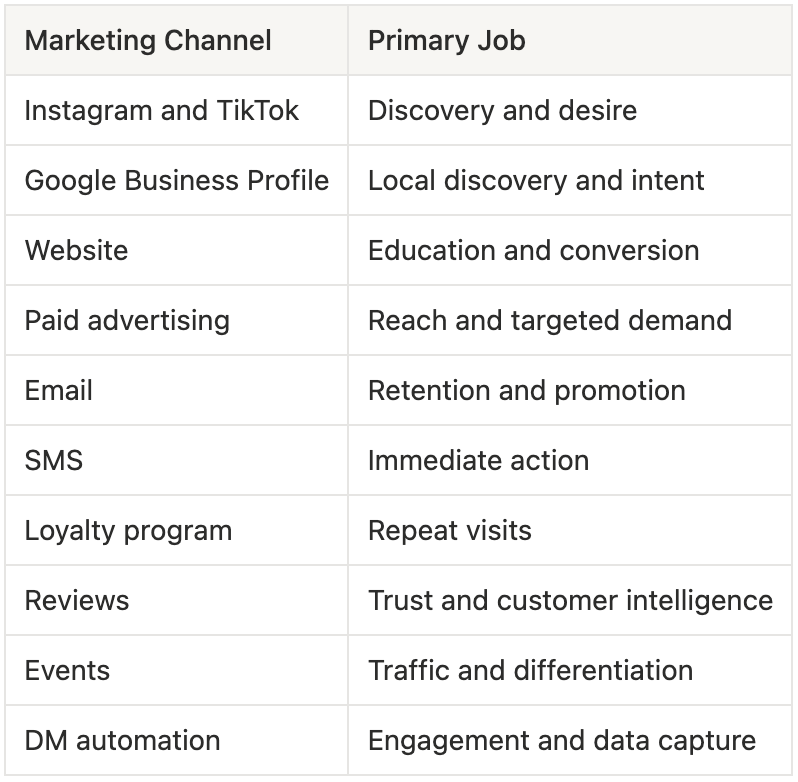
When these channels operate separately, marketing gets noisy.
When they work together, marketing starts producing measurable business results.
1. Social Media Works When It Creates Desire
Social media still works for restaurants in 2026.
Bad social media does not.
There is a big difference.
Posting another static photo of a cheeseburger with a caption that says, “Come try our delicious burger!” is not a strategy.
Restaurant social media should make someone stop scrolling and think:
I want to go there.
The content that consistently gives restaurants the best opportunity to create that response includes:
- Food being prepared
- Food builds
- Close up food photography
- Bartenders making cocktails
- Busy dining rooms
- Behind the scenes kitchen footage
- Chef personalities
- Customer reactions
- Events
- Limited time menu items
- Staff personalities
- Moments that show what dining at the restaurant actually feels like
The important word is feels.
People already know restaurants sell food.
Your marketing needs to show them why spending their Friday night at your restaurant will be better than spending it somewhere else.
Brand To Table Insight
One of the biggest mistakes we see is restaurants creating content entirely around the product.
Burger.
Pizza.
Steak.
Cocktail.
Repeat.
Food gets attention, but atmosphere, personality, hospitality, events, and experiences help sell the visit.
Stop selling dishes. Start selling moments.
That shift changes restaurant content from a digital menu into actual marketing.
2. Google Business Profile Is One of the Most Important Restaurant Marketing Channels
When somebody searches:
“Italian restaurant near me”
“best steakhouse near me”
“restaurants with outdoor dining”
“restaurants for date night”
they are showing buying intent.
They are not casually scrolling.
They are looking for somewhere to eat.
Google says local search results are primarily influenced by relevance, distance, and prominence. Complete business information, reviews, positive ratings, photos, videos, and accurate information can all help restaurants strengthen their presence in local search.
A restaurant's Google Business Profile should therefore be treated as a marketing channel, not an online phone book.
Restaurants should regularly manage:
- Hours
- Holiday hours
- Menu links
- Reservation links
- Ordering links
- Photos
- Videos
- Business categories
- Customer reviews
- Review responses
- Restaurant information
Google specifically allows restaurants to showcase menus, dishes, reservations, online ordering, offers, photos, and other information directly through their Business Profile.
For multi location restaurant groups, every location should be managed individually.
The photos, reviews, hours, links, and information need to reflect that specific restaurant.
3. Email and SMS Work Because You Own the Audience
A restaurant with 30,000 Instagram followers and 800 customer email addresses has a problem.
The restaurant has built an audience on rented land.
Social platforms are valuable for discovery, but restaurants should constantly create opportunities to turn anonymous followers and guests into known customers.
That means collecting:
- Email addresses
- Mobile numbers
- Birthdays
- Dining preferences
- Loyalty activity
- Reservation history
- Ordering behavior when available
Once you have permission to communicate with customers directly, you can create reasons for them to return.
Email works especially well for:
- New menu launches
- Events
- Wine dinners
- Holiday reservations
- Catering
- Seasonal promotions
- New locations
- Customer stories
- Loyalty offers
SMS works better when the message deserves immediate attention.
Think:
Tonight. This weekend. Limited availability. Reservations are open.
The mistake is using SMS like email and constantly blasting customers.
SMS should feel useful.
Not annoying.
4. Loyalty Programs Work When They Change Customer Behavior
A loyalty program should not exist simply because your POS system offers one.
Its job is to increase customer frequency, retention, or spending.
The National Restaurant Association reported that 70% of restaurant operators with loyalty programs said those programs helped increase customer traffic in its 2025 industry research. Loyalty membership also influenced restaurant selection across delivery, quick service, and table service customers.
That makes loyalty more than a discount program.
It is a behavioral marketing tool.
What We Look At With Restaurant Loyalty Programs
At Brand To Table, we are interested in questions like:
- How frequently do loyalty members visit?
- How frequently do nonmembers visit?
- What percentage of sales comes from loyalty members?
- What rewards are being redeemed?
- When are those rewards being redeemed?
- Are rewards driving incremental visits or discounting visits that would have happened anyway?
- Are customers stacking rewards with existing promotions?
- Does the reward structure encourage another visit?
This is where restaurant marketing starts becoming much more interesting.
For example, while reviewing loyalty data for one casual dining restaurant client, we found loyalty customers showing significantly stronger retention than non loyalty customers.
That tells us something important.
The loyalty program is not just another marketing expense.
It is potentially influencing customer behavior.
But that does not mean you blindly give away more discounts.
You study the data and adjust the program to encourage the behavior you actually want.
5. Reviews Should Be Used as Marketing Intelligence
Most restaurants look at reviews like this:
Five stars?
Great.
One star?
Problem.
That leaves an incredible amount of useful information on the table.
Restaurant reviews are one of the largest sources of free customer research available to an operator.
Read 100 recent reviews and start categorizing what customers mention.
Look for repeated comments about:
- Service
- Wait times
- Food quality
- Portion size
- Value
- Atmosphere
- Noise
- Cocktails
- Specific dishes
- Staff members
- Parking
- Reservations
- Cleanliness
- Special occasions
Then count the patterns.
If 23 customers mention your espresso martini without being asked, that is marketing intelligence.
If 17 people mention slow service on Saturday nights, that is operational intelligence.
If customers repeatedly mention how well your restaurant handles birthdays, that might be a positioning opportunity.
Google also confirms that reviews and positive ratings can contribute to local prominence and help businesses stand out in search results.
At Brand To Table, we believe reviews should influence marketing strategy, not just reputation management.
Your customers are literally telling you what they remember about your restaurant.
Listen to them.
6. Restaurant Events Work Because They Give People a Reason to Visit Now
One of the hardest problems in restaurant marketing is urgency.
People may like your restaurant.
They may follow your restaurant.
They may even intend to visit your restaurant.
But someday does not put anyone in a seat tonight.
Events solve that problem.
Wine dinners, chef dinners, tastings, game day experiences, live music, trivia, cocktail classes, seasonal events, and special menus create a specific reason to visit.
Industry research supports the demand for experiences. The National Restaurant Association reported strong consumer interest in restaurant tasting events, private chef dinners, and cooking classes.
Events also create something restaurants desperately need:
Content with a deadline.
Instead of saying:
“Come visit us.”
You can say:
“Thursday. 6:30 PM. Four courses. Limited seats.”
That is a much stronger marketing message.
7. Paid Restaurant Advertising Works Best When There Is a Specific Offer or Objective
“Boost this post.”
That is not a restaurant advertising strategy.
Before spending money, decide what action you want someone to take.
Examples include:
- Make a reservation
- Join the loyalty program
- Buy event tickets
- Order online
- Request catering information
- Book a private event
- Join an email or SMS list
- Visit a new restaurant location
Then build the campaign around that action.
Paid advertising becomes especially powerful when paired with strong organic content.
If a restaurant already has a video generating strong engagement organically, that creative has given you useful information.
People are interested.
Now you can put money behind proven creative instead of guessing.
For multi location restaurant groups, paid advertising should also be localized.
Someone living 40 miles away may love your video.
That does not mean they are driving 40 miles for Tuesday night dinner.
Reach is not the goal.
Relevant reach is.
8. DM Automation Turns Social Engagement Into Customer Data
This is one of the most underused restaurant marketing strategies in 2026.
Instead of telling customers:
“Link in bio.”
Give them a simple action.
Comment MENU.
Comment RESERVE.
Comment VIP.
Comment EVENT.
An automated conversation can then deliver the appropriate link or information directly through the customer's messages.
That reduces friction.
It can also create opportunities to collect customer information with permission.
For example:
Instagram Reel → Customer comments EVENT → Automated DM → Event information → Ticket link → Email capture
Now social media is doing more than generating likes.
It is moving somebody toward a business outcome.
That is the difference between social media management and restaurant marketing.
9. Value Works Better Than Constant Discounting
Restaurant customers are price conscious in 2026.
That does not mean restaurants need to race toward cheaper prices.
In the National Restaurant Association's Q3 2026 consumer research, 40% of consumers reported using more discounts or value promotions than usual. At the same time, restaurants remained the top discretionary spending priority among surveyed consumers.
Customers still want restaurants.
They are simply becoming more selective.
Your job is to communicate why the experience is worth the money.
Value can mean:
- Portion size
- Quality
- Hospitality
- Convenience
- Exclusivity
- Atmosphere
- Entertainment
- Rewards
- Bundled experiences
- Limited availability
Discounting is one form of value.
It is not the only form.
If the only way you know how to generate traffic is taking 20% off something, eventually you train customers to wait for the discount.
10. The Guest Experience Is Still Your Most Important Marketing Channel
Restaurants sometimes try to market their way out of an operational problem.
You cannot.
No amount of Instagram content fixes bad hospitality.
No Meta campaign fixes cold food.
No influencer fixes a rude bartender.
No loyalty program fixes a dirty dining room.
Marketing gets people through the door.
Operations determine whether they come back.
That is why we say:
Your restaurant's best social platform is its dining room floor.
Every table is a potential review.
Every birthday is potential user generated content.
Every great server can create a repeat customer.
Every beautifully presented dish can end up on Instagram.
Every great experience can become word of mouth.
Marketing and operations are not separate anymore.
The guest experience is part of the marketing strategy.
What Restaurant Marketing Should You Prioritize in 2026?
If your restaurant is trying to do everything at once, start with this order:
- Fix the guest experience. Make sure the product and service deserve repeat business.
- Fix your local discovery. Optimize Google Business Profile, reviews, website information, menus, ordering, and reservation paths.
- Create better content. Show food, people, atmosphere, experiences, and personality.
- Capture customer data. Build email, SMS, loyalty, and first party customer databases.
- Build retention campaigns. Give existing customers reasons to return.
- Create traffic drivers. Use events, experiences, seasonal promotions, and strategic offers.
- Add paid media. Amplify campaigns that already have a clear objective and strong creative.
- Measure what happened. Look at covers, reservations, redemptions, customer retention, event sales, and revenue.
Notice what is not at the top of that list.
Followers.
Likes.
Views.
Those numbers can be useful indicators.
They are not the business objective.
The Restaurant Marketing Metrics That Actually Matter
Restaurant owners should connect marketing performance to business performance whenever possible.
Track:
- Covers
- Reservations
- Average check
- Repeat visit rate
- Loyalty participation
- Loyalty redemption
- Email list growth
- SMS list growth
- Online orders
- Catering inquiries
- Private event inquiries
- Event ticket sales
- Review volume
- Review sentiment
- Cost per customer acquisition when measurable
- Revenue generated by specific campaigns when measurable
You can still track reach, views, engagement, and follower growth.
Just understand what they are.
They are leading indicators.
Revenue and customer behavior are the scoreboard.
What Does Not Work in Restaurant Marketing Anymore?
Restaurant marketing usually fails when activity gets confused with strategy.
Posting seven days a week does not automatically create demand.
Hiring an influencer does not automatically create customers.
Running ads does not automatically create reservations.
Sending emails does not automatically create repeat visits.
Having a loyalty program does not automatically create loyalty.
The question should always be:
What customer behavior are we trying to create?
Once you answer that question, choosing the marketing channel becomes much easier.
Frequently Asked Questions About Restaurant Marketing in 2026
What is the most effective restaurant marketing strategy in 2026?
The most effective restaurant marketing strategy combines local discovery, strong social content, customer data collection, email and SMS, loyalty, reviews, events, and paid advertising into one connected system designed to generate visits and repeat business.
Does social media still work for restaurants?
Yes. Social media works when restaurant content creates desire and shows the actual experience of visiting the restaurant. Food preparation, atmosphere, staff personalities, cocktails, events, and real customer experiences generally provide stronger marketing opportunities than repetitive promotional graphics.
Should restaurants focus on Instagram or TikTok?
Restaurants should use the platforms where their target customers spend time, but the bigger priority is producing strong short form video that can be distributed across multiple platforms. Do not build an entire marketing strategy around one algorithm.
Is email marketing still effective for restaurants?
Yes. Email is especially useful for events, seasonal menus, catering, holiday reservations, loyalty communication, new locations, and promotions. Unlike social followers, an opted in email database gives the restaurant a direct communication channel with customers.
Is SMS marketing worth it for restaurants?
SMS can be extremely useful when the message is timely and relevant. Restaurants should use SMS selectively for messages such as limited availability, weekend events, special menus, or time sensitive promotions rather than treating SMS like another daily advertising channel.
Do restaurant loyalty programs actually increase repeat business?
They can. Industry research shows restaurant operators report increased traffic from loyalty programs, but results depend on the program structure. Operators should measure visit frequency, retention, spending, reward redemption, and discount behavior instead of assuming the program works simply because customers enroll.
How important are Google reviews for restaurants?
Very important. Reviews influence customer trust and can contribute to a restaurant's prominence in Google's local search results. Restaurants should also analyze review language to identify repeated customer opinions about food, service, atmosphere, value, and specific menu items.
Should restaurants use influencers?
Influencers can be useful when the creator's audience matches the restaurant's target customer and the campaign has a clear objective. Follower count alone is not enough. Restaurants should evaluate local audience relevance, content quality, engagement, deliverables, and whether the partnership can create measurable actions.
How much should a restaurant spend on marketing?
There is no universal percentage that works for every restaurant. Marketing investment should depend on revenue, margins, growth goals, location count, competition, restaurant concept, current customer traffic, and whether the restaurant is launching, maintaining, or aggressively growing.
What should a restaurant measure besides social media engagement?
Restaurants should measure covers, reservations, average check, repeat visits, loyalty activity, email and SMS growth, online orders, catering leads, private event inquiries, event ticket sales, reviews, customer sentiment, and campaign revenue whenever attribution is possible.
The Bottom Line: Restaurant Marketing in 2026 Is About Building a System
Restaurant marketing in 2026 is not about finding the newest hack.
It is about building a system.
Get discovered.
Create desire.
Make taking action easy.
Capture the customer.
Deliver a great experience.
Give them a reason to return.
Measure what happened.
Then do more of what works.
At Brand To Table, that is how we approach restaurant marketing. We are not interested in creating content just to fill a calendar. We want to understand how marketing connects to reservations, covers, customer retention, loyalty, events, and revenue.
Because restaurant owners do not need more marketing activity.
They need marketing that moves the business forward.
If your restaurant or hospitality group has plenty of marketing activity but you cannot clearly explain how it connects to traffic, retention, and revenue, that is probably the first place to look.
Explore Brand To Table to learn more about building a restaurant marketing strategy designed around actual customer behavior and measurable business growth.
Need Help With Your Restaurant’s Marketing? Click Here To Book a Call With Henry

See Related Blog Posts
Insights, Ideas, and Marketing Inspiration for your restaurant.
.avif)
.jpeg)