
For established U.S. restaurants with room to grow and cash available to invest, Brand To Table recommends using 3% to 5% of net sales as a starting point for total ongoing marketing spend. A location pursuing faster growth can evaluate 5% to 8% for a defined campaign period, provided the margins, staffing, and results support it. These are our planning ranges, not a measured industry average. Your final budget should reflect what each location needs and can afford.
Total marketing spend includes the people, content, tools, and advertising needed to bring guests in and bring them back. If you budget $4,000 a month, that doesn’t mean you have $4,000 to hand to Meta.
Restaurant margins make this decision serious. The National Restaurant Association’s 2025 Operations Data Abstract reported median income before taxes of 2.8% of sales for full service respondents and 4.0% for limited service respondents in 2024. Those figures describe the surveyed restaurants, not targets for your business. Adding marketing expense without enough profitable sales can erase what’s left. National Restaurant Association
For this guide, net sales means restaurant revenue after discounts and refunds, excluding sales tax and tips. Use the same sales definition across locations so your budget comparisons mean something.
What Percentage of Sales Should a Restaurant Use for Marketing?
Start with a planning range, then check the actual work required, cash flow, and expected return.
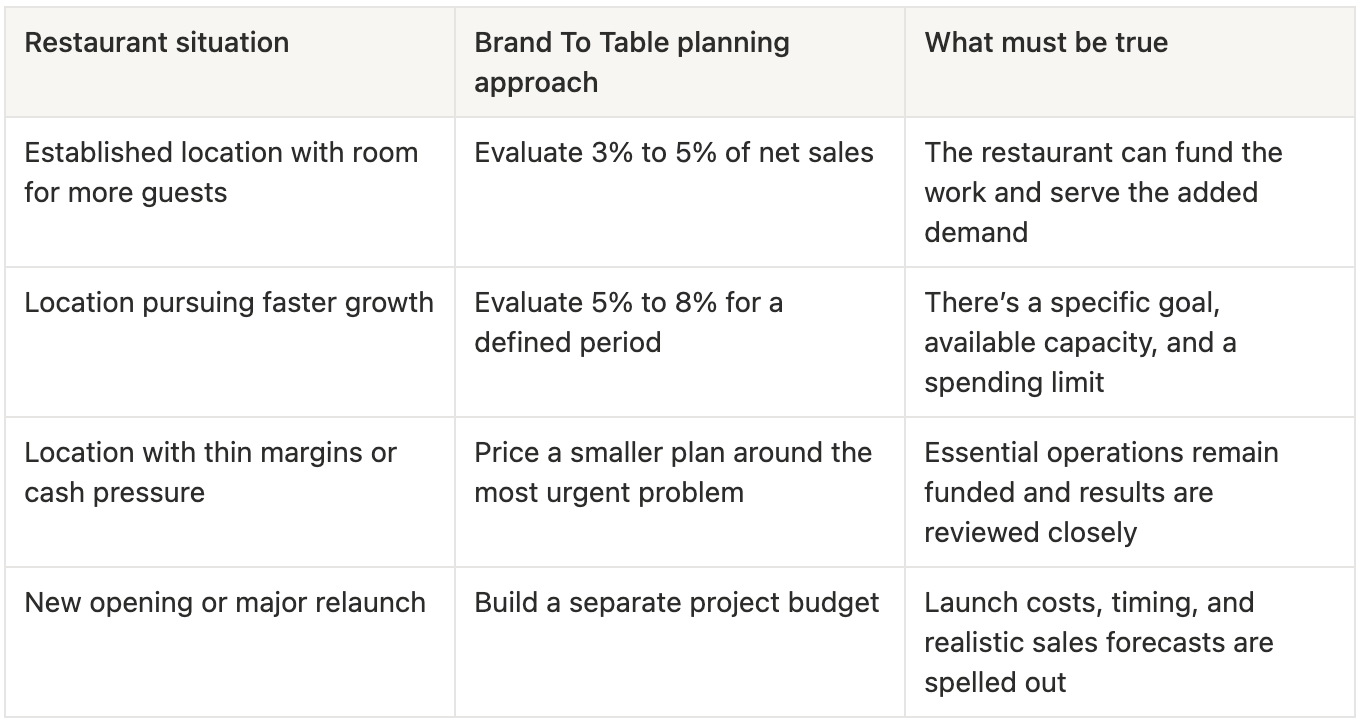
A restaurant doesn’t have to spend 5% because a spreadsheet says so. A profitable location with strong repeat business may need less. A struggling location may need operational repairs before it needs more advertising.
At Brand To Table, we use percentages to start the conversation. The business problem decides where the money goes.
What Does a Restaurant Marketing Budget Look Like in Dollars?
Multiply monthly net sales by the marketing percentage you’re evaluating.
Monthly marketing budget = monthly net sales × planned marketing percentage.
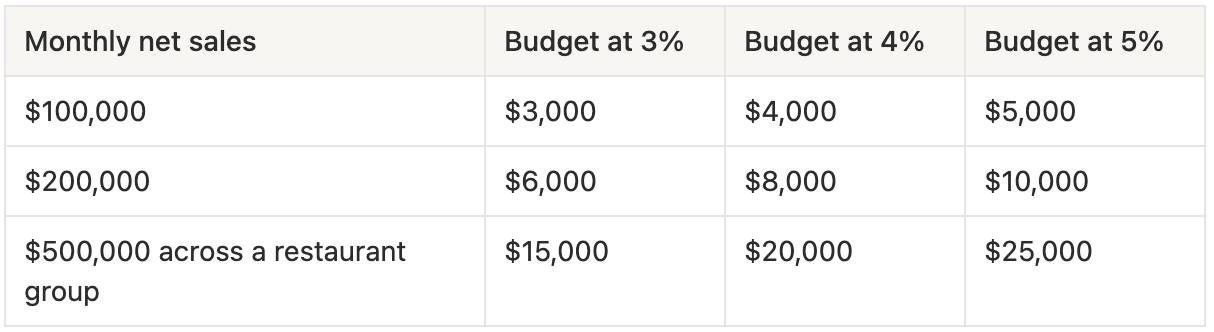
These figures are planning examples. They aren’t agency quotes or promises about results.
For a seasonal restaurant, build the annual plan around realistic annual sales. Schedule spending before the periods you want to fill. Recalculating the budget every slow month can cut support right when the next booking period needs attention.
What Should Be Included in a Restaurant Marketing Budget?
A useful restaurant marketing budget includes the full cost of doing the work.
The National Restaurant Association’s survey definition includes advertising, email and text campaigns, social media, public relations, loyalty programs, and other promotional activities. For planning purposes, Brand To Table also accounts for the people and production needed to run those activities. restaurant.org
Include:
- Strategy and management: Agency fees, dedicated marketing staff costs, planning, and reporting.
- Content production: Photography, video, design, and copywriting.
- Paid advertising: The money paid directly to advertising platforms.
- Guest communication: Email, SMS, loyalty communication, and DM automation.
- Website support: Relevant updates, landing pages, hosting, and marketing tools.
- Local promotion: Print materials, partnerships, and creator fees.
Count each cost once. If an agency package includes content and reporting, don’t add those services again as separate expenses.
Track major projects, such as a rebrand or website rebuild, separately from recurring work. Show both in the annual total so ownership can see the full investment.
If your restaurant pays a required franchise marketing contribution, include it before deciding how much additional local spending you can support.
How Could a Restaurant Divide a $4,000 Monthly Budget?
An established restaurant doing $100,000 in monthly net sales could evaluate the following $4,000 plan.
This is an illustrative allocation, not a required split or Brand To Table price list.
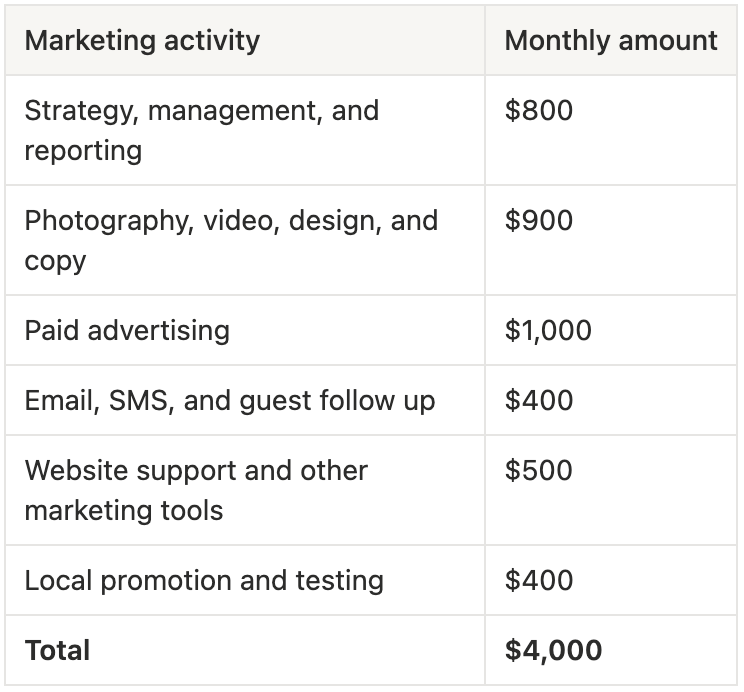
The allocation should change with the problem. A restaurant with plenty of interest but a confusing reservation page may need website work first. A restaurant with a strong guest list and weak repeat visits may need better follow up.
You don’t need a little money in every possible channel. You need enough support for the work most likely to help.
How Should Restaurant Groups Divide Marketing Spend Across Locations?
Restaurant groups should share costs where practical and assign local spending based on each restaurant’s needs.
A group can share brand direction, website infrastructure, design resources, and reporting. Each restaurant still needs accurate local information, relevant content, and a plan for its own trading area.
Imagine three locations:
- One location fills Saturday dinner but struggles on Tuesday.
- One location has strong lunch traffic but weak dinner awareness.
- One location has event space with open dates.
Equal ad budgets won’t address those three needs equally well.
At Brand To Table, our budgeting approach starts with the service or booking opportunity each location needs to improve. Then we price the work required to support it.
Assign each location a clear share of central marketing costs. Add its local spending. Review that total against the location’s sales and results. Otherwise, group reporting can hide a restaurant that’s spending heavily without gaining enough business.
What Does Restaurant Marketing Execution Teach Us About Budgeting?
Budget for Keeping Campaigns Accurate
Our Capital Craft work has included updating recurring promotion graphics across feed posts, stories, and print formats when the offers changed. Scheduled posts also needed the correct replacement files.
That work takes time, even when the campaign already exists.
A restaurant marketing budget needs to cover campaign upkeep as well as campaign creation. The practical lesson is to account for updates and approvals before the promotion starts.
A stale price in a scheduled story can become the manager’s problem during service.
Set Goals by Service Period
“Get more customers” is too loose to guide spending.
“Add 30 guests across Tuesday and Wednesday dinner each week” gives the team a target it can work with.
At a hypothetical $40 average spend per guest, 30 additional guests per week would produce $4,800 in added sales over four weeks. That’s a sales target, not profit or a guaranteed campaign result.
A goal tied to a service period helps Brand To Table connect the message, timing, budget, and manager’s report to the same outcome.
How Do You Know Whether Restaurant Marketing Is Paying for Itself?
Compare the full campaign cost with the money left from genuinely additional sales after the costs of serving those sales.
Added revenue and added profit are different numbers.
Consider a hypothetical campaign:

Break even added sales = total campaign cost ÷ contribution margin.
Contribution margin is the share of added sales left after costs such as food, extra labor, and transaction fees, before marketing expense. The 60% figure is an example, not a restaurant benchmark. Use your own costs, including extra staffing when needed.
In this example, $1,500 divided by 0.60 equals $2,500. At $40 per guest, the restaurant needs at least 63 additional guests to cover the campaign cost. Set the goal above break even so the work can produce a profit.
Count additional business carefully. A discount used by someone who already planned to visit isn’t proof that marketing created a new visit.
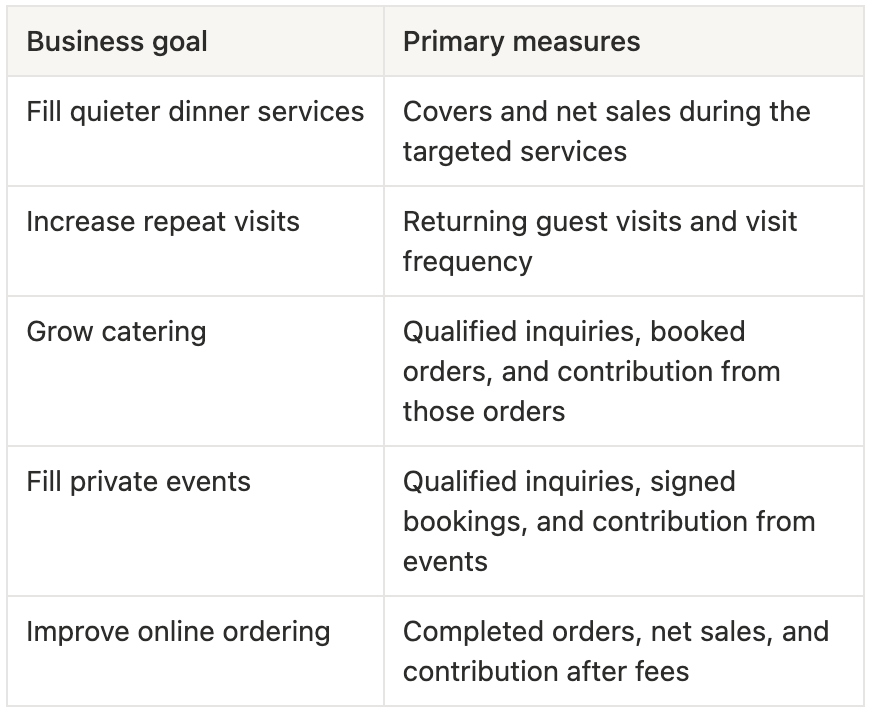
What Should Restaurant Owners Measure Each Month?
Give ownership and each GM a short report that connects spending to the goal.
.Should every restaurant location have the same marketing budget?
No. Share central costs where practical, then assign local spending based on demand, capacity, and business goals. Track results at each location.
Should a new restaurant spend a percentage of projected sales?
Use projected sales as a reasonableness check, but build the launch budget from actual needs and quotes. Track opening promotion and major setup projects separately from recurring marketing.
Should restaurants cut marketing when sales drop?
Review spending before cutting it. Stop waste and protect the work that’s producing profitable business. If cash is tight, narrow the plan to the most urgent problem.
How long should a restaurant test a marketing budget?
Set a review period based on the goal. A 90 day period can help assess an ongoing plan, with weekly delivery checks and monthly business reviews. Private event bookings may need a longer period to show completed revenue.
How can restaurant owners tell whether an agency fee is worth it?
Compare the scope, execution, and business results with the full cost. Ask what’s included, what requires extra spending, and how the agency will connect its work to your restaurant’s goals.
Need Help With Your Marketing? Click Here To Book a Call with Henry

See Related Blog Posts
Insights, Ideas, and Marketing Inspiration for your restaurant.
.jpeg)
.avif)