Brand To Table helps New Jersey restaurants build and execute social media strategies that are tied to actual business goals, not just likes, views, and posting frequency. We help restaurant owners decide what to promote, who they need to reach, what content needs to be created, when it should be published, and how social media connects to reservations, online orders, events, repeat visits, and revenue.
That distinction matters.
A restaurant does not need to post more just because someone says the algorithm wants more content. It needs a clear reason for every campaign it puts into the market.
For some restaurants, the priority might be filling slower Tuesday and Wednesday nights. For another restaurant, it might be increasing Sunday brunch reservations. A multi location group might need different strategies for each location because the customer, competition, and revenue opportunities are different.
That is how Brand To Table approaches restaurant social media.
We start with the business problem. Then we build the marketing around it.
What Does Social Media Strategy Mean for a Restaurant?
A restaurant social media strategy is a plan for using platforms like Instagram, Facebook, TikTok, and YouTube to influence specific customer behaviors.
Those behaviors may include:
- Making a reservation
- Ordering food online
- Visiting during a slower daypart
- Trying a new menu item
- Attending an event
- Joining a loyalty program
- Returning for another visit
- Joining an email or SMS list
- Sharing the restaurant with friends
Posting attractive food photos is only one part of the process.
A strong restaurant social media strategy connects content, offers, customer behavior, operations, advertising, and revenue goals.
At Brand To Table, we look at social media as one part of the restaurant's larger marketing system.
How Does Brand To Table Build a Social Media Strategy for New Jersey Restaurants?
Our process starts by understanding what the restaurant actually needs to accomplish.
We do not start by asking, "What should we post this week?"
We start with questions like:
- Which days are underperforming?
- Which dayparts need more traffic?
- What menu categories need more attention?
- Are there events coming up?
- Is the restaurant trying to grow lunch, dinner, brunch, happy hour, takeout, or late night business?
- Which locations have different needs?
- What offers are currently available?
- What customer groups should we be targeting?
- What does the restaurant want customers to do after seeing the content?
Once those answers are clear, the content strategy becomes much easier to build.
Example
If a New Jersey restaurant has strong Friday and Saturday dinner traffic but weak Tuesday nights, producing another general video saying "Come visit us this weekend" probably does not solve the real problem.
The content strategy should focus on creating a reason to visit Tuesday.
That might involve:
- Creating a Tuesday specific offer.
- Producing video content around that offer.
- Publishing content before customers make their dining decision.
- Supporting the campaign through email, SMS, Meta advertising, or direct message automation when appropriate.
- Tracking whether Tuesday traffic improves.
That is strategy.
Posting a reel because the kitchen made something that looked good is content production.
Restaurants need both, but they are not the same thing.
Brand To Table Builds Content Around Restaurant Revenue Opportunities
One of the biggest mistakes we see is restaurants creating content first and figuring out what to do with it later.
We work in the opposite direction.
Before a restaurant video shoot, we look at the upcoming marketing calendar and identify what assets are actually needed.
A shoot might need content for:
- A new menu launch
- Sunday brunch
- Football season
- Happy hour
- A grand opening
- Private events
- Lunch traffic
- Late night dining
- Online ordering
- Catering
- Holiday reservations
- Customer testimonials
- Staff and hospitality content
- Paid Meta advertising
This allows the restaurant to get more value out of every photography and video session.
Instead of leaving a shoot with 40 random clips of food, the restaurant leaves with content that has a job to do.
We Do Not Film Food Just Because the Restaurant Likes It
Restaurant owners naturally get excited about their food.
They should.
But the dishes the owner personally loves are not always the dishes that should receive the most marketing attention.
We look at content through the customer's eyes.
Which dishes create curiosity?
Which items are visually easy to understand?
Which dishes are strong entry points for somebody who has never visited before?
Which items support the campaign we are currently running?
Which experiences make someone think, "I want to be there"?
That last question is especially important.
The best restaurant marketing does not simply show people food.
It helps people envision themselves having the experience.
That is why Brand To Table social media strategies often include more than close up food shots.
We want to capture:
- Guests enjoying themselves
- Servers interacting with tables
- Bartenders making drinks
- Food arriving at the table
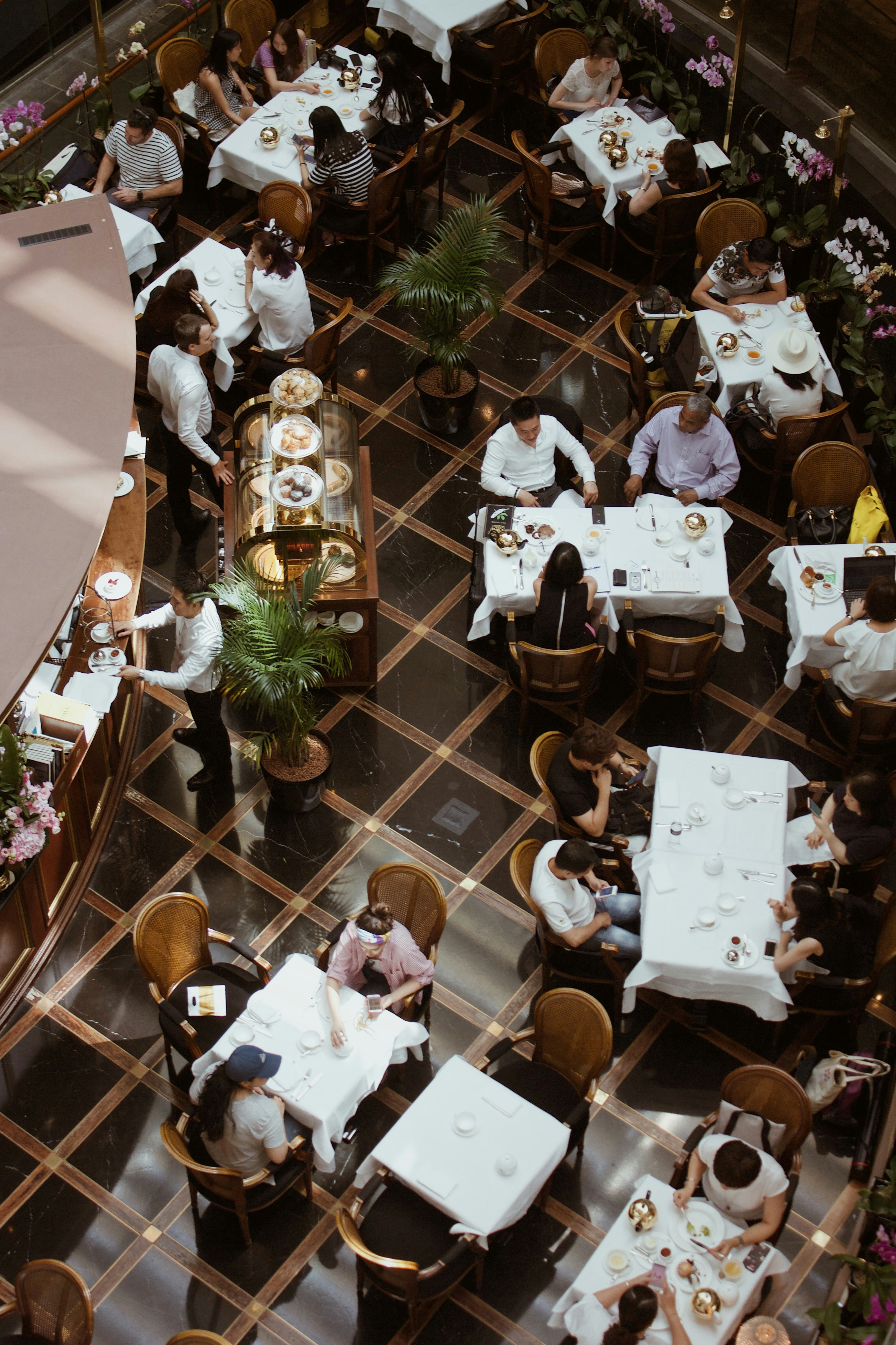
- Busy dining rooms
- Kitchen activity
- Chefs plating dishes
- Groups celebrating
- The atmosphere during important dayparts
- The people behind the restaurant
Food gets attention.
Experience creates desire.
How Brand To Table Handles Social Media Implementation
Strategy does not mean much if nobody executes it.
Brand To Table can help manage the implementation of the restaurant's social media plan, including the coordination of content, campaigns, publishing, creative, and supporting marketing channels.
Depending on the restaurant's needs, implementation can include:
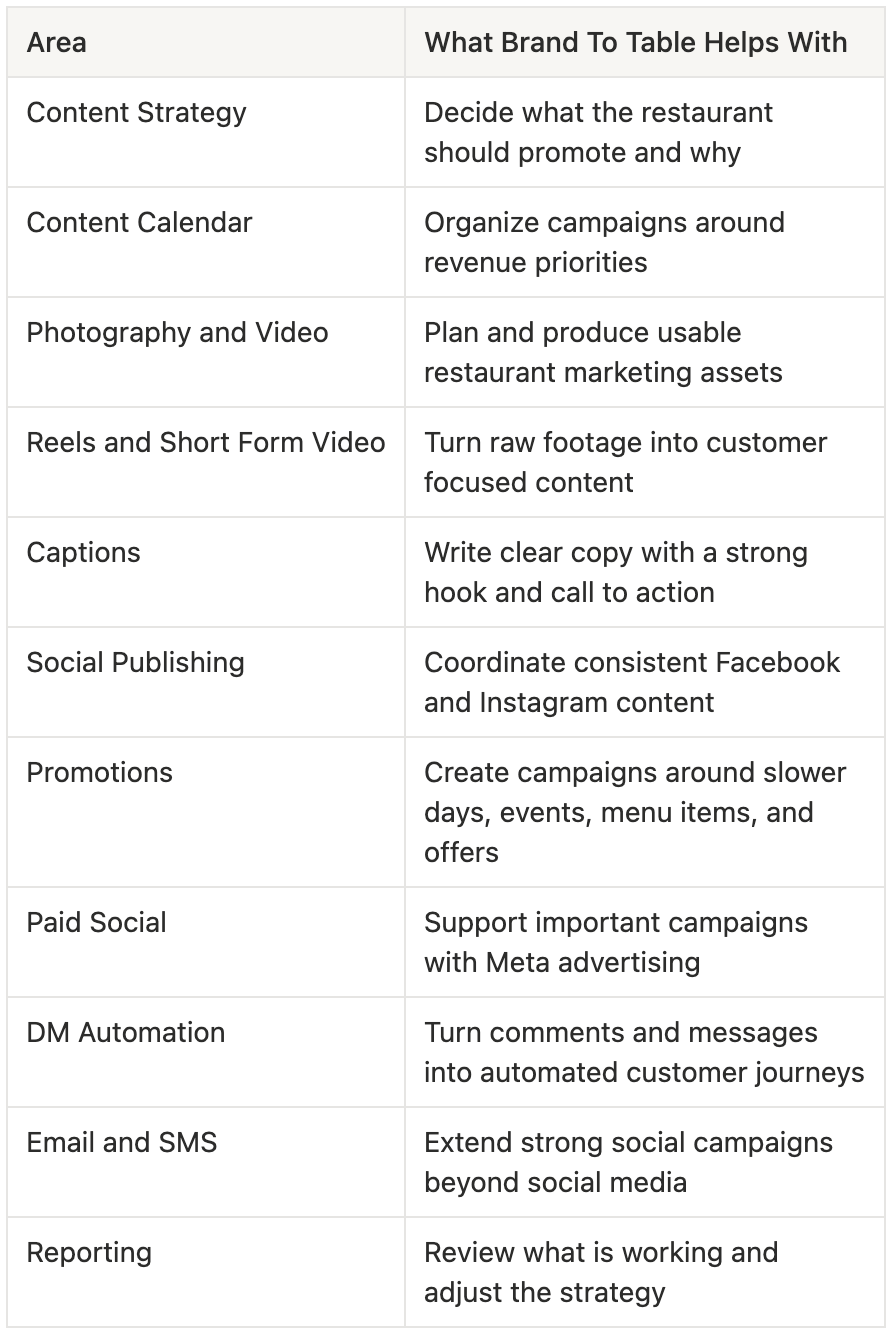
The goal is to create one connected system instead of having five different marketing tactics operating separately.
Social Media Should Not Operate in a Vacuum
A restaurant might have a great Instagram account and still struggle to generate repeat business.
That is because Instagram alone is not a complete restaurant marketing system.
For example, imagine a restaurant is promoting a special event.
Social media can create awareness.
Meta advertising can reach more people in the local market.
A comment automation can send interested customers the registration link.
Email can reach previous guests.
SMS can remind customers closer to the event.
The restaurant's website or reservation platform can complete the conversion.
Each channel supports the same business objective.
Brand To Table's role is to make those pieces work together.
Why Local Strategy Matters for New Jersey Restaurants
New Jersey restaurant marketing is extremely local.
A strategy that works for a restaurant in Jersey City may not make sense for a restaurant in Sparta, Morristown, East Hanover, Lawrenceville, or the shore.
Even restaurants within the same hospitality group can require different strategies.
A location near a major highway may benefit from commuter focused messaging.
A restaurant inside a shopping mall needs to think differently about customer acquisition than a freestanding destination restaurant.
A neighborhood restaurant may depend heavily on frequency and repeat visits.
A higher end restaurant may care more about reservations, occasions, and guest experience.
A sports bar might build campaigns around football Saturdays and Sundays.
Brand To Table does not believe every restaurant should follow the same social media playbook.
The marketing should fit the location, concept, customer, operational reality, and revenue opportunity.
What We Commonly See When Taking Over Restaurant Social Media
Across restaurant accounts, we repeatedly see the same problems.
Random Posting
Someone takes a picture, sends it to the social media person, and it gets posted.
There is no connection to a larger campaign.
Too Much Food Content
The feed becomes an endless collection of burgers, pizza, cocktails, pasta, and steak.
The customer never sees the hospitality, atmosphere, personalities, or experience.
No Clear Call to Action
Customers see the content but are never told what to do next.
Should they reserve?
Order?
Comment?
Visit this weekend?
Join the loyalty program?
The post needs a purpose.
Promotions Start Too Late
Restaurants sometimes begin marketing an event only a few days before it happens.
Strong restaurant campaigns need enough time to create awareness and repetition.
Every Location Gets the Same Marketing
Multi location operators often use identical content everywhere even when each location has different customers and business challenges.
Brand To Table looks for those gaps and builds the strategy around fixing them.
How We Measure Whether Restaurant Social Media Is Working
Likes are useful signals, but they are not the final goal.
The metrics that matter depend on the campaign.
Brand To Table may look at:
- Reservations
- Covers
- Online orders
- Offer redemptions
- Event registrations
- Direct messages
- Loyalty signups
- Email or SMS growth
- Website traffic
- Cost per result from advertising
- Repeat visits
- Revenue during targeted days or dayparts
A viral reel can be valuable.
But 100,000 views from people who live nowhere near the restaurant may be less useful than 10,000 views from people who can actually become customers.
Restaurants should measure attention based on whether that attention has the potential to influence the business.
Our Philosophy: Marketing, Hospitality, and Operations Have to Work Together
Social media cannot fix everything.
Great marketing can convince somebody to visit your restaurant once.
What happens next depends on the restaurant.
Our philosophy at Brand To Table is simple:
Marketing gets people through the door.
Hospitality makes them feel valued.
Operations determine whether they come back.
The best social media campaign in New Jersey cannot overcome bad service, inconsistent food, confusing offers, or a poor customer experience.
Marketing creates the opportunity.
The restaurant still has to deliver.
That is why we approach restaurant marketing from a bigger business perspective instead of treating social media like an isolated creative service.
Frequently Asked Questions About Restaurant Social Media Marketing
Does Brand To Table manage social media for New Jersey restaurants?
Yes. Brand To Table helps New Jersey restaurants with social media strategy, content planning, creative production, publishing, campaigns, and implementation. The exact scope depends on the needs of the restaurant or hospitality group.
What social media platforms should a restaurant use?
For most restaurants, Instagram and Facebook remain important platforms because they support visual content, local discovery, advertising, events, and customer engagement. Short form video can also be repurposed for platforms such as TikTok and YouTube Shorts when it makes sense for the restaurant.
The right platform mix depends on the restaurant's audience and goals.
How often should a restaurant post on social media?
There is no universal number.
A restaurant should publish enough quality content to remain visible without posting content simply to hit a quota.
Brand To Table focuses on campaign consistency, content quality, timing, and business purpose rather than chasing an arbitrary posting frequency.
What type of social media content works best for restaurants?
Strong restaurant social media usually combines food, people, atmosphere, hospitality, personality, education, offers, events, and reasons to visit.
The exact mix depends on what the restaurant is currently trying to accomplish.
Should every restaurant reel promote a special offer?
No.
Some content should build brand awareness, trust, familiarity, and desire.
Other content should ask customers to take a specific action.
The important part is knowing the purpose of the content before it is created.
Can Brand To Table create restaurant photography and video content?
Yes. Content production can be planned around the restaurant's larger marketing strategy so photography and video assets can support organic social media, paid advertising, promotions, email marketing, websites, and future campaigns.
Does Brand To Table work with multi location restaurants?
Yes. Multi location restaurant groups often need both a shared brand strategy and individual marketing plans for each location.
One restaurant may need help filling lunch while another needs stronger weekend traffic. Treating every location exactly the same can hide those opportunities.
How far in advance should restaurants plan social media campaigns?
Major campaigns should usually be planned several weeks ahead whenever possible.
Seasonal promotions, grand openings, holidays, football season, restaurant events, menu launches, and other important revenue opportunities are easier to market when strategy and content production happen before the campaign needs to go live.
Should restaurants use paid social media advertising?
Paid advertising can be valuable when a restaurant has a strong offer, event, message, or reason to visit.
Advertising does not automatically make weak marketing better.
Brand To Table typically looks at the campaign, audience, geographic market, creative, offer, and conversion path before deciding how paid media should be used.
How is Brand To Table different from a traditional social media agency?
Brand To Table approaches social media from the perspective of restaurant growth rather than content production alone.
We look at what the restaurant needs to sell, when it needs more customers, what content needs to be created, how customers should respond, and how social media connects with the rest of the restaurant's marketing.
We are not trying to fill a content calendar.
We are trying to help fill the restaurant.
Your Restaurant Does Not Need More Random Content
Restaurant social media should have a purpose.
Every campaign does not need to produce an immediate sale, but the overall strategy should support the restaurant's business goals.
That is the difference between simply maintaining a social media account and using social media as part of a real restaurant marketing system.
Brand To Table helps New Jersey restaurant owners, hospitality groups, chefs, general managers, and marketing directors build that system.
We connect strategy, content, social media, advertising, customer communication, and restaurant revenue so the marketing has a clear direction.
If your restaurant is posting consistently but you are still wondering whether any of it is actually helping the business, that is the conversation we should be having.
Explore Brand To Table's restaurant marketing services and see how we can help turn your social media activity into a strategy built around real business goals.
Need Help? Click Here To Book a Call With Henry

See Related Blog Posts
Insights, Ideas, and Marketing Inspiration for your restaurant.

.avif)
.jpeg)