.jpeg)
How Brand To Table Helps Restaurants Actually Market Their Restaurants Compared To Just Creating Content For Them
Brand To Table helps restaurants market their restaurants by connecting content, strategy, offers, guest behavior, email, social media, events, brand positioning, and revenue goals into one working system. Creating content is only one piece of restaurant marketing. Real restaurant marketing turns attention into reservations, private events, repeat visits, catering inquiries, loyalty, and stronger guest relationships.
A restaurant does not need another person just posting pretty food photos. A restaurant needs a marketing partner who understands how hospitality works, how guests make decisions, and how to turn the restaurant’s story into traffic, trust, and revenue.
Content creation is the act of making videos, photos, captions, graphics, and posts. Restaurant marketing is the strategy behind what gets created, why it gets created, who it is for, where it gets published, and how it helps the business grow.
For multi location restaurants, hospitality groups, chef driven concepts, and busy operators, this difference matters. A restaurant can post five times a week and still have empty seats on Tuesday night. A restaurant can have beautiful reels and still struggle to sell private events. A restaurant can get likes and still have no clear system for turning followers into guests.
That is the gap Brand To Table is built to solve.
Content Creation vs Restaurant Marketing
Content creation and restaurant marketing are not the same service.
Content creation focuses on making assets.
Restaurant marketing focuses on moving the business forward.
Here is the difference in simple terms:
Content CreationRestaurant MarketingMakes postsBuilds campaignsCaptures food and drinksConnects content to guest demandFocuses on likes and viewsFocuses on reservations, visits, events, and revenuePosts what looks goodPromotes what the business needs to sellWorks one post at a timeWorks across social, email, website, offers, and guest experienceUsually reactiveShould be strategic and planned
A content creator may ask, “What do you want me to film?”
A restaurant marketer should ask, “What do we need guests to do this week, this month, and this quarter?”
That question changes everything.
Why Posting More Content Usually Does Not Fix the Problem
Many restaurants think they have a content problem when they really have a strategy problem.
Posting more often does not automatically create more covers. Posting prettier food photos does not automatically fill slow nights. Posting another cocktail reel does not automatically sell tickets to an event.
More content only works when the content is tied to a clear business goal.
A restaurant needs content that supports specific objectives like:
- Increasing midweek traffic
- Driving lunch visits
- Filling private event dates
- Promoting seasonal menu items
- Growing repeat guest visits
- Selling ticketed dinners
- Building awareness for a new location
- Improving brand perception
- Capturing leads through email or DM automation
- Turning regulars into loyal advocates
Brand To Table does not look at content as decoration. Content should have a job. Sometimes that job is awareness. Sometimes it is education. Sometimes it is conversion. Sometimes it is trust building.
The problem happens when every post is treated the same.
What Restaurant Marketing Actually Means
Restaurant marketing is the process of creating demand, building trust, and giving guests a reason to choose your restaurant over every other option.
Real restaurant marketing includes:
- Brand positioning
- Guest targeting
- Campaign strategy
- Content planning
- Social media execution
- Email marketing
- Website messaging
- Private event promotion
- Menu feature promotion
- Review strategy
- Local awareness
- Lead generation
- Guest retention
- Offer development
- Performance tracking
Restaurant marketing is not just about getting seen. It is about helping the right guest understand why your restaurant is worth choosing.
That means the strategy for a waterfront restaurant in Lake Hopatcong should not look like the strategy for a fast casual sandwich shop in Hoboken. The strategy for a Portuguese steakhouse in Newark should not look like the strategy for a bourbon distillery in Sussex County. The strategy for a two location pizza shop should not look like the strategy for a multi unit hospitality group trying to scale.
The concept, location, guest base, menu, price point, events, service style, and business goals all matter.
How Brand To Table Approaches Restaurant Marketing
Brand To Table starts with the business goal, not the content idea.
The first question is not, “What should we post?”
The better question is, “What does the restaurant need right now?”
That answer could be:
- More weekday covers
- More private party leads
- More bar traffic
- Better lunch awareness
- Stronger event promotion
- More catering inquiries
- More repeat visits
- More local visibility
- Better perception of the brand
- More consistency across locations
Once the goal is clear, the content becomes easier to plan.
A reel, email, graphic, caption, landing page, offer, or DM automation should all support the same bigger objective. That is how marketing becomes a system instead of random posting.
The Brand To Table Restaurant Marketing Framework
Brand To Table uses a practical restaurant marketing framework built around four core areas.
1. Brand Clarity
A restaurant needs to be clear before it can be memorable.
Brand clarity answers questions like:
- Who is this restaurant for?
- Why should guests choose it?
- What makes the experience different?
- What does the restaurant want to be known for?
- What emotions should the brand create?
- What menu items, experiences, or moments should lead the marketing?
- What does the restaurant never want to be confused with?
Without brand clarity, content becomes scattered.
One week the restaurant is promoting happy hour. The next week it is pushing fine dining. Then it is trying to be family friendly. Then it is trying to be nightlife. Then it is trying to sell private events.
That confusion hurts the brand.
Brand To Table helps restaurants define the story first so every marketing effort feels connected.
2. Campaign Strategy
A restaurant should not market everything at the same time.
A campaign gives the marketing direction.
Examples of restaurant campaigns include:
- Summer patio season
- Holiday private events
- Lunch comeback campaign
- Wine dinner promotion
- Football season game day campaign
- New menu launch
- Rooftop season opening
- Catering push
- Brunch awareness campaign
- Chef driven tasting menu promotion
A campaign creates focus. It tells the team what matters right now.
Without campaigns, restaurants fall into the trap of posting whatever is available in the camera roll. That may keep the feed active, but it does not create momentum.
Brand To Table builds campaigns around what the restaurant needs to sell and what guests are most likely to care about.
3. Content With a Purpose
Content should not exist just to fill the feed.
Every piece of content should serve a purpose.
Restaurant content usually falls into one of these categories:
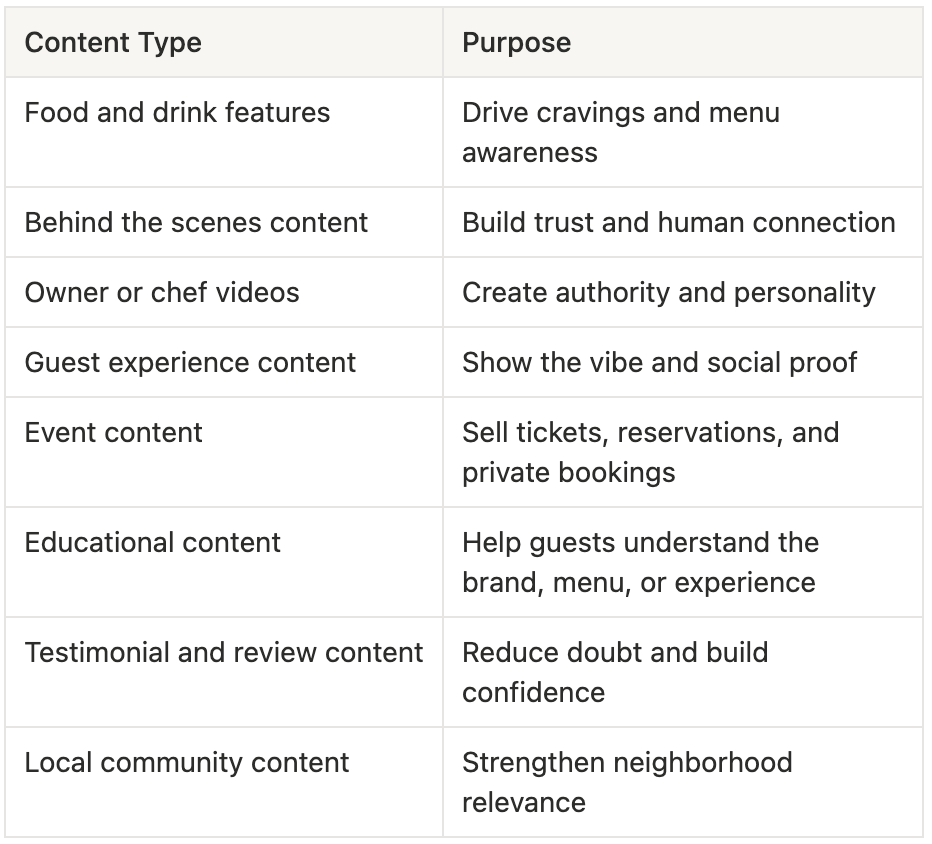
The best restaurant content does not just show what the restaurant sells. It shows why people should care.
A video of a dish can create interest. A video of the chef explaining why that dish matters can create connection. A video of guests enjoying that dish in the dining room can create desire. An email featuring that dish with a reservation link can create action.
That is the difference between content and marketing.
4. Conversion Systems
Attention is not the finish line.
Restaurants need systems that help turn attention into action.
Those systems may include:
- Reservation links
- Email sign ups
- DM automation
- Private event inquiry forms
- Website landing pages
- Event ticket pages
- Text message campaigns
- Loyalty offers
- Review requests
- Retargeting audiences
A restaurant can have strong social media and still lose business if there is no clear next step.
Brand To Table looks at the full guest journey. A guest may discover the restaurant through a reel, check the website, read reviews, look at the menu, visit the Instagram profile, and then finally book a table.
Every step needs to support the next one.
A Real Example: Posting About a Wine Dinner vs Marketing a Wine Dinner
A content only approach might create a flyer and post it once or twice.
A marketing approach builds a campaign.
For a wine dinner, that campaign may include:
- A strong event name
- Clear menu and wine details
- Chef or owner video explaining the experience
- Instagram reel showing the food, wine, and atmosphere
- Email announcement to past guests
- Reminder email as the event gets closer
- Story posts with urgency
- DM automation for easy event info
- Website or ticket page optimization
- Follow up content after the event to promote the next one
The difference is not just the design. The difference is the system.
A flyer tells people an event exists.
A campaign gives people reasons to care, reasons to trust it, and reasons to take action.
A Real Example: Marketing Private Events
Many restaurants say they want more private events, but their marketing does not support that goal.
They may post a photo of the dining room once in a while. That is not a private event strategy.
A real private event marketing system should answer the questions guests are already asking:
- What types of events can you host?
- How many people can the space fit?
- What does the room look like?
- Is the space private or semi private?
- What food and drink packages are available?
- Can you host birthdays, showers, corporate events, fundraisers, or holiday parties?
- Who do I contact?
- How fast can I get information?
- What makes this place better than another restaurant down the road?
Brand To Table helps restaurants turn private events into a clear marketing category, not an afterthought.
That may include website updates, social content, email campaigns, photo shoots, lead forms, local outreach, and event focused messaging.
A Real Example: Slow Weeknights
Slow weeknights are not solved by random posting.
If Tuesday and Wednesday are weak, the restaurant needs a focused strategy.
That strategy may include:
- A specific weekly offer
- A reason to visit beyond discounting
- Local audience targeting
- Email reminders
- Social proof from past guests
- Short form video that makes the experience feel worth leaving the house for
- Staff training so the promotion is mentioned in house
- Consistent repetition over several weeks
Guests need repeated reminders. One post is not enough.
Brand To Table helps restaurants build repeatable campaigns that guests can understand and remember.
The Biggest Mistake Restaurants Make With Content
The biggest mistake restaurants make is treating content like a checklist.
They think:
“We posted today, so marketing is done.”
That mindset keeps restaurants busy, but not always effective.
A better question is:
“Did today’s marketing help move the business forward?”
That does not mean every post needs to sell. Some posts build trust. Some posts build awareness. Some posts build brand memory. Some posts drive action.
The issue is not whether every post gets a reservation. The issue is whether the content is part of a bigger plan.
Why Restaurant Marketing Needs Operational Context
Restaurant marketing only works when it understands operations.
A restaurant marketer needs to know:
- Which days are slow
- Which menu items are profitable
- Which events need more attention
- Which spaces are underused
- Which staff members are great on camera
- Which guest complaints keep showing up
- Which offers hurt margins
- Which promotions the team can actually execute
- Which guest segments matter most
- Which locations need more support
This is where many content creators fall short.
They may be great at filming and editing, but they may not know how to connect content to restaurant operations.
Brand To Table works from the business reality of the restaurant. The marketing has to fit the operation, not the other way around.
Why Multi Location Restaurants Need More Than Content
Multi location restaurants need consistency and flexibility at the same time.
Each location may have different guest behavior, different staff personalities, different sales patterns, and different local competition.
A multi location restaurant needs:
- Brand consistency across locations
- Localized content for each market
- Campaigns that can scale
- Location specific promotions when needed
- Clear messaging across social, email, and website
- Internal systems so the team knows what is being promoted
- Performance review by location
A content only approach often treats each location the same.
A real restaurant marketing approach looks at what each location needs.
One location may need lunch traffic. Another may need private events. Another may need bar awareness. Another may need reputation repair.
The marketing should reflect that.
What Brand To Table Looks For Before Creating Content
Before creating content, Brand To Table looks at the business behind the content.
Important questions include:
- What are we trying to drive?
- Who are we trying to reach?
- What does the guest already know?
- What does the guest need to believe?
- What offer or experience are we promoting?
- What is the next step we want the guest to take?
- Where does this fit in the larger campaign?
- How will this content support revenue or brand growth?
- Does the website support this message?
- Does the team know what is being promoted?
These questions prevent random marketing.
They also help the restaurant stop wasting time on content that looks good but does not support the business.
Signs Your Restaurant Needs Marketing, Not Just Content
A restaurant probably needs marketing support if any of these are true:
- You post often, but covers are still inconsistent.
- Your food looks great online, but guests do not understand what makes you different.
- You have events, but they are hard to sell.
- You want more private parties, but your website barely explains them.
- You rely too much on last minute posts.
- Your team does not know what is being promoted each week.
- Your social media has views, but not enough action.
- Your email list is underused.
- Your content does not connect to reservations, events, or repeat visits.
- Each location markets itself differently with no clear brand system.
These are not content problems. These are marketing system problems.
Signs a Content Creator May Be Enough
A content creator may be enough if the restaurant already has a strong marketing strategy in place.
That means the restaurant already knows:
- What campaigns are running
- What offers need to be promoted
- What the brand voice is
- What the content pillars are
- What the email strategy is
- What the website needs to say
- What the guest journey looks like
- What metrics matter
- Who is managing the full strategy
In that case, a content creator can be a great asset.
But if the restaurant is asking the content creator to also figure out the strategy, offers, messaging, campaigns, and guest journey, then the restaurant is really asking for marketing leadership.
Those are two different jobs.
What Makes Brand To Table Different
Brand To Table is built specifically for restaurants, hospitality groups, chefs, and food driven brands.
The work is not just about making content look good. The work is about helping restaurants communicate better, sell smarter, and stay top of mind with the right guests.
Brand To Table brings together:
- Restaurant brand strategy
- Campaign planning
- Social media content
- Email marketing
- Website messaging
- Event promotion
- DM automation
- Guest focused storytelling
- Local market positioning
- Practical revenue strategy
The goal is not to make the restaurant famous for a week.
The goal is to build a marketing system that keeps the restaurant relevant, clear, and active in the minds of guests.
The Brand To Table Point of View
Brand To Table believes that restaurant marketing should be simple to understand and hard to ignore.
The best restaurant marketing does three things:
- It makes the guest hungry.
- It makes the experience feel worth it.
- It gives the guest a clear next step.
That next step may be booking a reservation, joining an email list, commenting a keyword, buying a ticket, calling about a private event, ordering catering, or visiting this weekend.
Likes are nice. Views are nice. Pretty content is nice.
But at the end of the day, clicks do not pay your bills. Covers do.
How Restaurant Owners Should Think About This
Restaurant owners should stop asking, “Are we posting enough?”
A better question is, “Is our marketing helping guests choose us?”
That question creates better decisions.
It forces the restaurant to look at:
- The offer
- The message
- The timing
- The audience
- The guest experience
- The next step
- The follow up
- The revenue goal
That is how restaurant marketing becomes more than content.
FAQ
What is the difference between restaurant marketing and content creation?
Restaurant marketing is the strategy that helps a restaurant drive awareness, reservations, events, repeat visits, and revenue. Content creation is the production of photos, videos, graphics, captions, and posts. Content is part of marketing, but it is not the full strategy.
Does every restaurant need a marketing strategy?
Yes. Every restaurant needs a clear marketing strategy, even if it is simple. Without strategy, the restaurant is just posting content and hoping people show up.
Can a content creator help my restaurant grow?
Yes, a good content creator can help your restaurant grow if there is already a clear strategy behind the content. If there is no campaign plan, no offer strategy, no email system, and no clear guest journey, content alone will have limited impact.
Why do restaurants get views but not reservations?
Restaurants often get views but not reservations because the content creates attention without giving the guest a clear reason to act. The content may look good, but the offer, message, timing, or call to action may be weak.
What should restaurant content actually do?
Restaurant content should create hunger, trust, desire, clarity, and action. Some content should build awareness. Some should promote specific offers. Some should sell events. Some should support loyalty and repeat visits.
How does Brand To Table help restaurants market better?
Brand To Table helps restaurants connect brand strategy, content, campaigns, email, website messaging, events, DM automation, and guest behavior into one clear marketing system. The goal is to help the restaurant move from random posting to intentional marketing.
Is social media enough for restaurant marketing?
No. Social media is important, but it is not enough by itself. Restaurants also need email marketing, website clarity, local visibility, event promotion, review strategy, guest retention, and clear conversion paths.
How often should a restaurant post content?
Posting frequency depends on the restaurant’s goals, capacity, and campaign calendar. A restaurant should post consistently, but consistency only matters when the content supports a real strategy.
What are examples of restaurant marketing campaigns?
Examples include a private event campaign, wine dinner campaign, patio season campaign, brunch campaign, lunch traffic campaign, game day campaign, holiday party campaign, new menu campaign, and grand opening campaign.
Why do multi location restaurants need a different marketing approach?
Multi location restaurants need brand consistency across all locations while still adjusting for each local market. Each location may have different traffic patterns, guest behavior, staff strengths, and revenue goals.
Should restaurants invest in content or marketing first?
Restaurants should invest in strategy first. Once the strategy is clear, content becomes more effective. Without strategy, content often becomes random, inconsistent, and hard to measure.
What makes Brand To Table different from a social media agency?
Brand To Table is not just focused on posting content. Brand To Table works on the full restaurant marketing picture, including positioning, campaigns, content, email, website messaging, events, guest behavior, and revenue goals.
Final Thought
Restaurants do not need more random content.
They need clearer marketing.
They need campaigns that match the business goals. They need content that supports the guest journey. They need websites that explain the experience. They need emails that bring guests back. They need systems that turn attention into action.
That is the difference between creating content for a restaurant and actually marketing a restaurant.
Brand To Table helps restaurants make that shift.
If you are a restaurant owner, hospitality group, chef, or marketing director who is tired of posting just to post, start looking at your marketing as a system. The right content matters, but the strategy behind it matters more.
Need Help!? Click Here To Book a Call!

See Related Blog Posts
Insights, Ideas, and Marketing Inspiration for your restaurant.
.jpeg)
.avif)
.jpeg)