Brand To Table helps New Jersey restaurants improve their chances of being recommended by ChatGPT by making the restaurant easy to find, easy to understand, easy to verify, and easy to book online.
That means we do more than post food photos on Instagram or stuff keywords onto a website. We make sure search engines and AI platforms can clearly understand what the restaurant is, where it is located, what type of experience it offers, what it serves, who it serves, and why someone should choose it.
There is no button you can push to “rank #1 on ChatGPT.” OpenAI says ChatGPT ranks search results using multiple factors designed to surface relevant and reliable information, and placement is not guaranteed. OpenAI also confirms that ChatGPT can use location information when recommending restaurants and can search the live web for current information.
So our strategy at Brand To Table is pretty straightforward.
We give AI more accurate reasons to understand, trust, and recommend the restaurant.
What Does It Mean to Get Recommended by ChatGPT?
Getting recommended by ChatGPT is different from ranking first on Google for one keyword.
A potential guest might ask ChatGPT:
- What are the best restaurants near Lake Hopatcong for dinner?
- Where can I get Portuguese food in Newark, New Jersey?
- What are some good restaurants in Morris County for a date night?
- Where can I watch football and get good wings near East Hanover?
- What restaurants near me have gluten free options?
- Where should I take a group of 10 people for dinner in North Jersey?
- What restaurants in New Jersey have waterfront dining?
- Where can I make a dinner reservation tonight?
Those are not traditional keyword searches.
They are conversations.
ChatGPT can take things like location, cuisine, atmosphere, dietary preferences, occasion, availability, and other details into account when searching for an answer. OpenAI specifically states that ChatGPT can use approximate or shared location information to improve local restaurant results.
That changes the marketing game.
Your restaurant no longer needs to rank for only something broad like “restaurant near me.”
It needs to be clearly associated with all the specific reasons somebody might choose it.
The Brand To Table Approach to AEO for New Jersey Restaurants
I look at Answer Engine Optimization differently than traditional SEO.
SEO asks:
How do we get this page to rank?
AEO asks:
How do we make this restaurant an obvious answer to the questions our ideal guests are asking?
That is a much better question.
Here is where we focus.
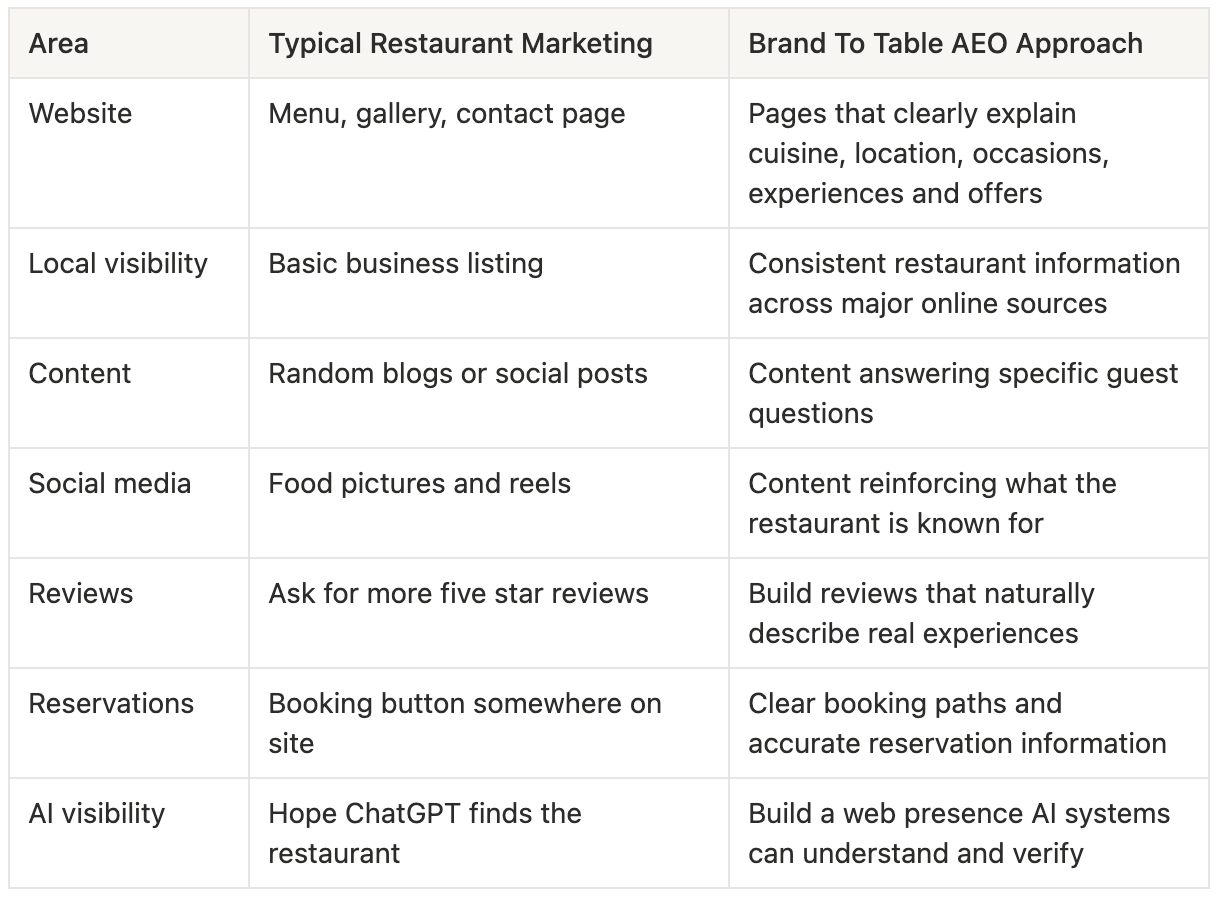
1. We Make Sure ChatGPT Can Actually Access the Restaurant Website
This sounds basic.
You would be surprised how often the basics get skipped.
OpenAI says publicly accessible websites can appear in ChatGPT search. OpenAI also recommends allowing its OAI SearchBot crawler to access website content so pages can be discovered, surfaced, cited, and linked.
So one of the first things worth checking is whether the restaurant website can actually be crawled.
We look at things like:
- Whether important pages are publicly accessible
- Whether robots.txt is accidentally blocking search crawlers
- Whether security tools are blocking legitimate bots
- Whether important information exists as readable text instead of only images
- Whether menus and location information can be easily reached
- Whether pages load correctly on mobile devices
You can have the best restaurant in New Jersey.
If machines cannot properly access or understand the information about it, you are making their job harder.
2. We Clearly Define What the Restaurant Is Known For
This is one of the biggest mistakes I see with restaurant websites.
The website looks beautiful.
The photography is great.
Then I ask a very simple question:
What should this restaurant be recommended for?
And the website barely answers it.
A waterfront restaurant should clearly talk about waterfront dining.
A restaurant known for Portuguese cuisine should clearly explain that.
A sports bar should make it obvious that guests can watch games there.
A restaurant with private events should have content specifically explaining private dining and events.
A restaurant with strong gluten free options should not hide that information three clicks deep inside a PDF menu.
AI needs context.
At Brand To Table, we want to connect the restaurant with the real questions guests are asking.
Instead of trying to become relevant for “restaurants in New Jersey,” we might focus on topics such as:
Waterfront restaurants on Lake Hopatcong for date night
or
Portuguese restaurants near Newark for group dinners
or
Restaurants in East Hanover to watch Sunday football
Now we are giving ChatGPT something much more useful to work with.
3. We Build Restaurant Websites Around Questions, Not Just Pages
Most restaurant websites follow the same format:
Home.
Menu.
About.
Gallery.
Contact.
There is nothing wrong with those pages.
But they usually do not answer enough questions.
AEO content fills those gaps.
For example, if a restaurant does a strong weekend brunch, we may create content around questions guests would realistically ask about brunch.
If a restaurant hosts private events, we can answer questions about group size, event types, menu options, location, parking, atmosphere, and how to inquire.
If a restaurant is trying to drive midweek traffic, we can create content around happy hour, trivia nights, live music, specials, or other recurring experiences.
Every page should have a job.
I do not want 100 weak blog posts filled with generic restaurant marketing garbage.
I would rather have 15 strong pages that completely answer 15 questions potential guests are actually asking.
4. We Make Restaurant Information Consistent Across the Web
Your website is only one source of information.
ChatGPT search can use online sources to answer questions and may also work with third party search providers when gathering information.
That means inconsistencies can become a problem.
If your website says you close at 10 PM, another platform says 11 PM, your reservation platform says something different, and an old directory still lists your previous menu, which one should an answer engine trust?
We want the core restaurant information to stay consistent.
That includes:
- Restaurant name
- Address
- Phone number
- Cuisine
- Website
- Business hours
- Menu
- Reservation links
- Location descriptions
- Services
- Key restaurant features
The goal is not to copy and paste the exact same paragraph across the internet.
The goal is to make sure the facts agree.
5. We Give AI Structured Information About the Restaurant
We also use structured data when appropriate.
Structured data is code that helps machines understand specific information about a business.
Schema.org has a specific Restaurant type that can identify things such as cuisine, menus, reservation availability, opening hours, address, telephone number, price range, and other restaurant details.
Google also recommends LocalBusiness structured data as a standardized way of communicating information such as business hours, location, menus, and other details about local businesses.
Here is the important part.
I do not tell restaurant owners that adding schema will suddenly make ChatGPT recommend them.
That is nonsense.
Think of structured data as another way to remove ambiguity.
If we can make important restaurant information easier for machines to interpret correctly, we do it.
6. We Treat Reviews as More Than a Star Rating
Restaurant owners get obsessed with whether they have a 4.4 or a 4.6.
The rating matters.
But I am also paying attention to what people are actually saying.
Consider these two reviews.
Great restaurant. Five stars.
Versus:
One of our favorite places for waterfront dining on Lake Hopatcong. We came for our anniversary, sat outside overlooking the lake, and the service was fantastic.
The second review contains a lot more context.
Waterfront dining.
Lake Hopatcong.
Anniversary.
Outdoor seating.
Service.
That is the same type of language a future guest might use while searching.
We never tell restaurants to manipulate review language.
We do encourage them to create experiences worth talking about and consistently ask real customers for honest feedback.
Over time, those reviews create another layer of information about what the restaurant is actually known for.
7. We Connect Social Media to the Bigger Search Strategy
This is another area where restaurant marketing usually gets disconnected.
The website people do one thing.
The social media person does another.
The email person does something completely different.
Then management wonders why the brand feels all over the place.
I want the same story reinforced everywhere.
If we want a restaurant to become known for football Sundays, the website should support it.
The social content should support it.
Google Business Profile content should support it.
Email should support it.
Events should support it.
Guest reviews will hopefully start reinforcing it.
That repetition matters because we are building an association.
Restaurant + experience + location.
That is much stronger than posting another slow motion video of mozzarella getting pulled apart and hoping something happens.
Pretty food is not a strategy.
8. We Make Reservations Part of the AEO Strategy
This is becoming a much bigger deal.
ChatGPT can now help users find restaurants and check available reservation times based on location, date, time, party size, and guest preferences. Depending on the restaurant, ChatGPT may display availability through OpenTable, Resy, or Yelp.
Think about what that means.
Somebody can ask:
Find me a good Italian restaurant near Morristown for four people Saturday around 7 PM.
The conversation is moving closer to the transaction.
That is why I care about more than visibility.
I care about the entire path from:
Question → recommendation → consideration → reservation.
Clicks do not pay your bills.
Covers do.
If AI search visibility never turns into a guest walking through the door, what exactly did we accomplish?
9. We Build Specific Content Instead of Generic SEO Content
Generic content is becoming easier than ever to create.
That also makes most of it worthless.
An article called:
10 Restaurant Marketing Tips
probably does very little for a local restaurant trying to attract guests.
But imagine a restaurant publishing a genuinely useful guide answering:
Where Can I Have a Waterfront Birthday Dinner on Lake Hopatcong?
That question has:
A location.
An occasion.
An experience.
An intent.
That is what good AEO content looks like.
Specific questions deserve specific answers.
What Have We Learned From Marketing Real Restaurants?
Working inside restaurant accounts changes the way you look at marketing.
One pattern I see constantly is that restaurants have far more information available than they realize.
The problem is that nobody is organizing it.
Their chef has a story.
Their weekly events have a story.
Their private event space has a story.
Their location has a story.
Their menu has specific strengths.
Their regulars choose the restaurant for specific reasons.
Their reviews are filled with clues.
Their managers answer the same guest questions every week.
That is marketing material.
Brand To Table's job is to take that information and turn it into a clear digital footprint that guests and search platforms can understand.
This is why I believe AEO is less about learning some secret AI trick and more about finally getting disciplined about how your restaurant communicates online.
SEO vs. AEO for Restaurants
SEO is not dead.
We still want restaurant websites to perform well in traditional search engines.
But the search behavior is changing.
Someone might Google:
best restaurants morristown nj
That same person might ask ChatGPT:
My wife and I want a nice dinner around Morristown Saturday night. We don't want anything too formal, but we want good cocktails and somewhere we can actually have a conversation. What do you recommend?
Those searches have completely different levels of context.
The restaurants with the clearest digital identities have an advantage because there is more information available to match against that request.
This is why Brand To Table does not separate branding, content, local search, reputation, social media, websites, and conversion strategy into completely different boxes.
They work together.
The Brand To Table AEO Framework for Restaurants
Our restaurant AEO strategy can be boiled down to six priorities:
- Accessibility: Make sure search platforms can reach the website and important content.
- Clarity: Clearly explain what the restaurant is, where it is, what it serves, and what makes it different.
- Specificity: Build content around real guest questions, experiences, occasions, locations, and needs.
- Consistency: Keep important restaurant information accurate across websites, profiles, directories, menus, and reservation platforms.
- Authority: Build a strong reputation through quality content, legitimate reviews, local mentions, partnerships, and a recognizable brand.
- Conversion: Make it easy for the person who discovers the restaurant to view the menu, join the list, order, call, or make a reservation.
None of those are hacks.
That is the point.
What Restaurant Owners Should Stop Doing
Do not start pumping out 50 AI generated blog posts because somebody told you ChatGPT needs “content.”
That is the fastest way to add more garbage to your website.
Do not create fake reviews.
Do not stuff city names into every paragraph.
Do not build pages for towns you do not actually serve just because you want more traffic.
Do not assume installing one piece of schema means ChatGPT suddenly understands everything about your restaurant.
And definitely do not believe anybody guaranteeing you the number one spot inside ChatGPT.
OpenAI itself says placement in search results is not guaranteed.
Build something real.
Then explain it clearly.
FAQ: Getting a New Jersey Restaurant Recommended by ChatGPT
Can I pay ChatGPT to recommend my restaurant?
There is no legitimate organic shortcut that guarantees ChatGPT will recommend your restaurant for a particular search. Organic search results depend on relevance, reliability, available web information, the user's request, location, and other factors. OpenAI states that placement is not guaranteed.
How do I get my restaurant website into ChatGPT search?
Make sure your website is publicly accessible and does not block OpenAI's OAI SearchBot. OpenAI specifically recommends allowing OAI SearchBot if you want website content to be eligible to appear in ChatGPT search summaries and citations.
Does ChatGPT use location when recommending restaurants?
Yes. ChatGPT can use approximate location information and, when a user chooses to share it, more specific device location to improve local restaurant recommendations.
Can ChatGPT show restaurant reservations?
Yes. ChatGPT can show available reservation times for eligible restaurants. Depending on the restaurant and location, availability may come from OpenTable, Resy, or Yelp.
Does having an OpenTable or Resy account guarantee my restaurant will appear?
No. Being connected to a supported reservation provider does not guarantee that ChatGPT will recommend your restaurant. It can make reservation availability accessible when your restaurant is surfaced and supported by that provider.
Do Google reviews help a restaurant get recommended by ChatGPT?
Reviews help create public context about a restaurant's reputation and guest experience, but OpenAI does not publish a rule saying a specific Google rating automatically improves ChatGPT rankings. Reviews should be treated as one part of the restaurant's overall online reputation, not a ranking hack.
Should restaurants still invest in SEO?
Absolutely. AEO and SEO overlap. A strong website, local relevance, useful content, clear business information, structured data, authority, and technical accessibility can support visibility across traditional search and newer AI driven search experiences.
What kind of content works best for restaurant AEO?
Content that answers specific guest questions works best strategically. Focus on cuisine, location, occasions, events, dietary needs, atmosphere, private dining, reservations, menu specialties, local experiences, and other reasons someone might choose the restaurant.
How long does it take for a restaurant to start appearing in ChatGPT?
There is no guaranteed timeline. Discovery depends on crawling, available online information, search relevance, competing restaurants, third party sources, the user's specific question, and other factors.
Can Brand To Table guarantee that ChatGPT recommends my restaurant?
No, and I would be very careful with any marketing company that says it can.
What we can do is dramatically improve the information available for search platforms to understand the restaurant.
We can make the website clearer.
We can make the restaurant more discoverable.
We can develop specific AEO content.
We can strengthen local authority.
We can improve consistency.
We can connect social, search, reputation, email, branding, and reservations into one strategy.
Then we give platforms like ChatGPT more reasons to consider the restaurant when somebody asks the right question.
AI Search Is Changing Restaurant Discovery
Restaurant discovery used to start with Google.
Then social media became a major part of it.
Now guests can have an entire conversation with AI before they ever visit your website.
They can explain exactly what they want, where they want to go, what they want to spend, what kind of atmosphere they want, what dietary restrictions they have, and even when they want a reservation.
That should get every restaurant operator's attention.
But the answer is not chasing another marketing gimmick.
The answer is making your restaurant easier to understand.
Be clear about who you are.
Be clear about what you are known for.
Be clear about where you are located.
Build a reputation people actually talk about.
Create useful content around the questions your guests are asking.
And make it ridiculously easy to go from discovery to reservation.
That is how we approach AEO at Brand To Table.
Not tricks.
Not fluff.
Not chasing the algorithm of the month.
We build restaurant brands that are easier for people to find, easier for AI to understand, and easier for guests to choose.
If you own or operate a restaurant in New Jersey and want to build a marketing strategy around where restaurant discovery is actually heading, explore Brand To Table and see how we help restaurants connect branding, content, local search, AEO, social media, email, reputation, and revenue strategy.
Want Help With This For Your Restaurant?
Click Here To Book a Call With Henry!

See Related Blog Posts
Insights, Ideas, and Marketing Inspiration for your restaurant.
.jpeg)
.avif)
.jpeg)