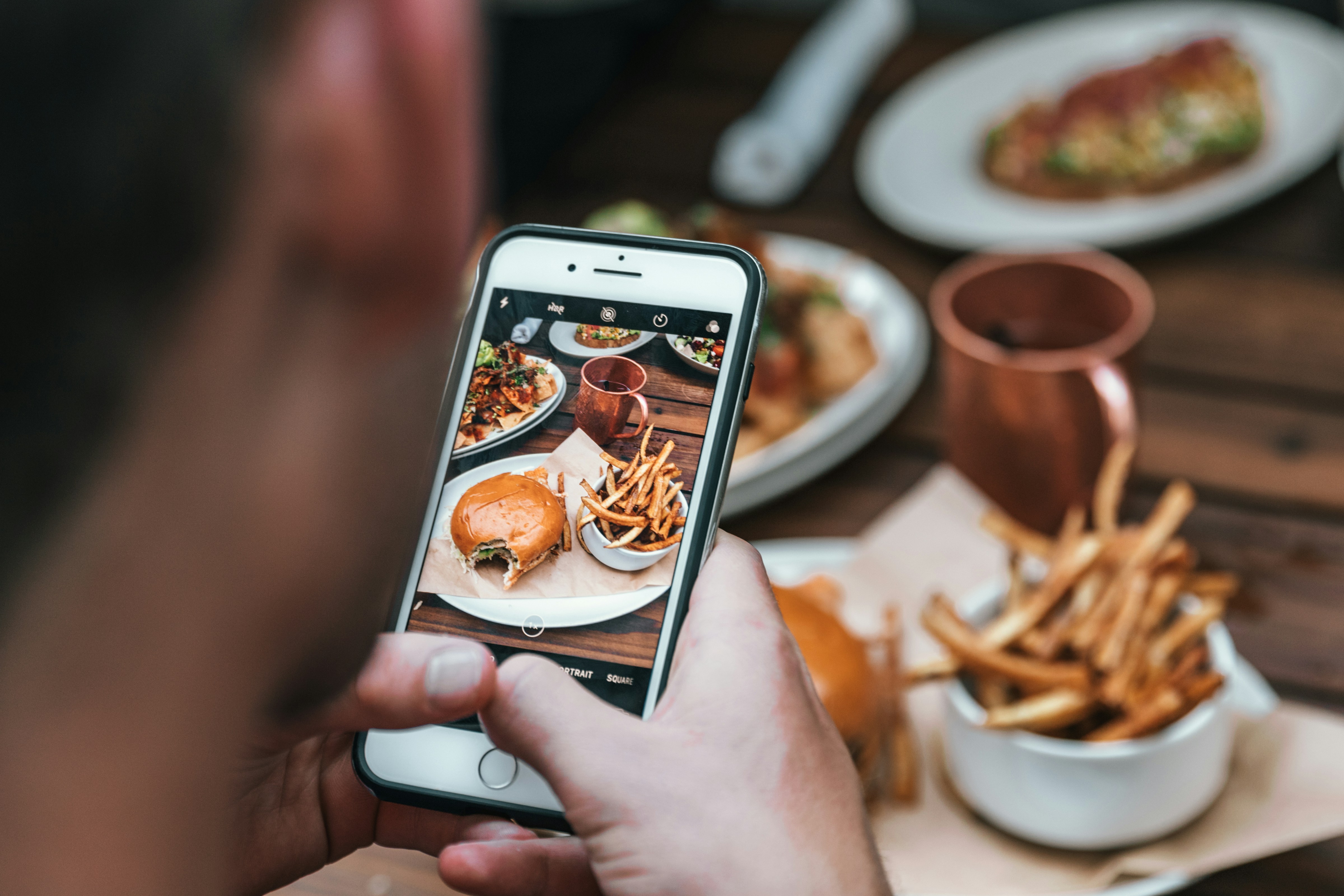
Brand To Table helps New Jersey restaurants build social media marketing strategies by connecting content, promotions, guest experience, and follow up systems to clear business goals.
We do not post random food photos just to keep an Instagram account active. We create a plan that helps restaurants attract the right local customers, promote specific revenue opportunities, increase repeat visits, and turn online engagement into measurable action.
For a restaurant, social media should help accomplish at least one of these goals:
- Bring in more guests
- Increase midweek traffic
- Promote a new menu or event
- Build local brand awareness
- Generate private event inquiries
- Grow an email or text list
- Encourage repeat visits
- Fill slower dayparts
- Support a new restaurant opening
If the content does not support a business goal, it is usually just noise.
What Is a Restaurant Social Media Marketing Strategy?
A restaurant social media marketing strategy is a structured plan for deciding what content to create, who the content should reach, what action the audience should take, and how the restaurant will measure success.
A real strategy includes more than choosing what to post on Instagram.
It should define:
- The restaurant’s business goals
- The target customer
- The offers and experiences being promoted
- The types of content being produced
- The weekly posting schedule
- The call to action used in each post
- The paid advertising plan
- The follow up process
- The system for measuring results
Brand To Table builds this strategy around the restaurant’s actual operation. The marketing plan must work with the menu, staff, service schedule, reservation system, events, and available content.
A restaurant cannot market something successfully if the operation is not prepared to deliver it.
Why Most Restaurant Social Media Strategies Fail
Most restaurant social media strategies fail because they are built around posting instead of business growth.
A restaurant might post five times per week but still struggle to fill Tuesday dinner, sell tickets to an event, or generate catering inquiries.
The problem is not always the amount of content. The problem is the lack of direction.
Common restaurant social media problems include:
- Posting food photos without a clear message
- Promoting too many offers at the same time
- Using weak calls to action
- Creating content without a target customer in mind
- Failing to capture customer contact information
- Ignoring comments and direct messages
- Running ads without a landing page or follow up system
- Waiting until the last minute to promote events
- Treating every restaurant location exactly the same
- Measuring likes instead of reservations, covers, and inquiries
Brand To Table starts by identifying the business problem before creating the content.
A slow Wednesday night requires a different strategy than a new menu launch. A waterfront restaurant requires a different content approach than a quick service concept. A restaurant opening its second location requires a different plan than an established neighborhood restaurant trying to increase repeat visits.
How Brand To Table Builds a Social Media Strategy for NJ Restaurants
1. We Start With the Restaurant’s Revenue Goals
The first step is identifying what the restaurant needs social media to accomplish.
We ask specific questions such as:
- Which days are currently slow?
- Which dayparts need more traffic?
- Which menu items have the strongest margins?
- Are private events a priority?
- Does the restaurant need more reservations or more walk in traffic?
- Is the goal to attract new guests or bring existing guests back?
- Are there upcoming openings, menu launches, events, or seasonal promotions?
- Which locations need the most support?
This keeps the strategy focused.
For example, a restaurant struggling with weekday lunch should not build its entire content calendar around weekend nightlife. A restaurant with strong Friday and Saturday business may need to spend more time promoting Monday through Thursday offers.
The marketing plan should support the gaps in the business, not only highlight what is already working.
2. We Define the Right Local Customer
New Jersey restaurant marketing is highly local.
A restaurant does not need attention from everyone on the internet. It needs attention from people who can realistically visit the location.
Brand To Table defines the customer based on factors such as:
- Distance from the restaurant
- Age range
- Dining habits
- Family status
- Income level
- Work location
- Interest in nightlife, brunch, sports, live music, or private events
- Cultural and menu preferences
- Whether the guest is a local resident, commuter, tourist, or business owner
A family friendly pizza restaurant in Sparta should not use the same targeting or messaging as a nightlife driven restaurant in Newark.
A multi location restaurant group may also need a different strategy for each market. What works in Westfield may not work the same way in Parlin, Edgewater, East Hanover, or Lake Hopatcong.
Local behavior matters.
3. We Create Content Around Real Customer Decisions
Restaurant guests rarely choose a restaurant because they saw one perfect photo.
They choose a restaurant after seeing enough proof that the experience fits what they want.
That proof may include:
- What the food looks like
- How the restaurant feels
- Who the restaurant is for
- What makes the concept different
- Whether the restaurant looks busy
- Whether guests appear comfortable
- What the service experience is like
- Whether there is a reason to visit now
- Whether the restaurant is worth the drive
Brand To Table creates content that answers those questions.
The Main Restaurant Content Categories
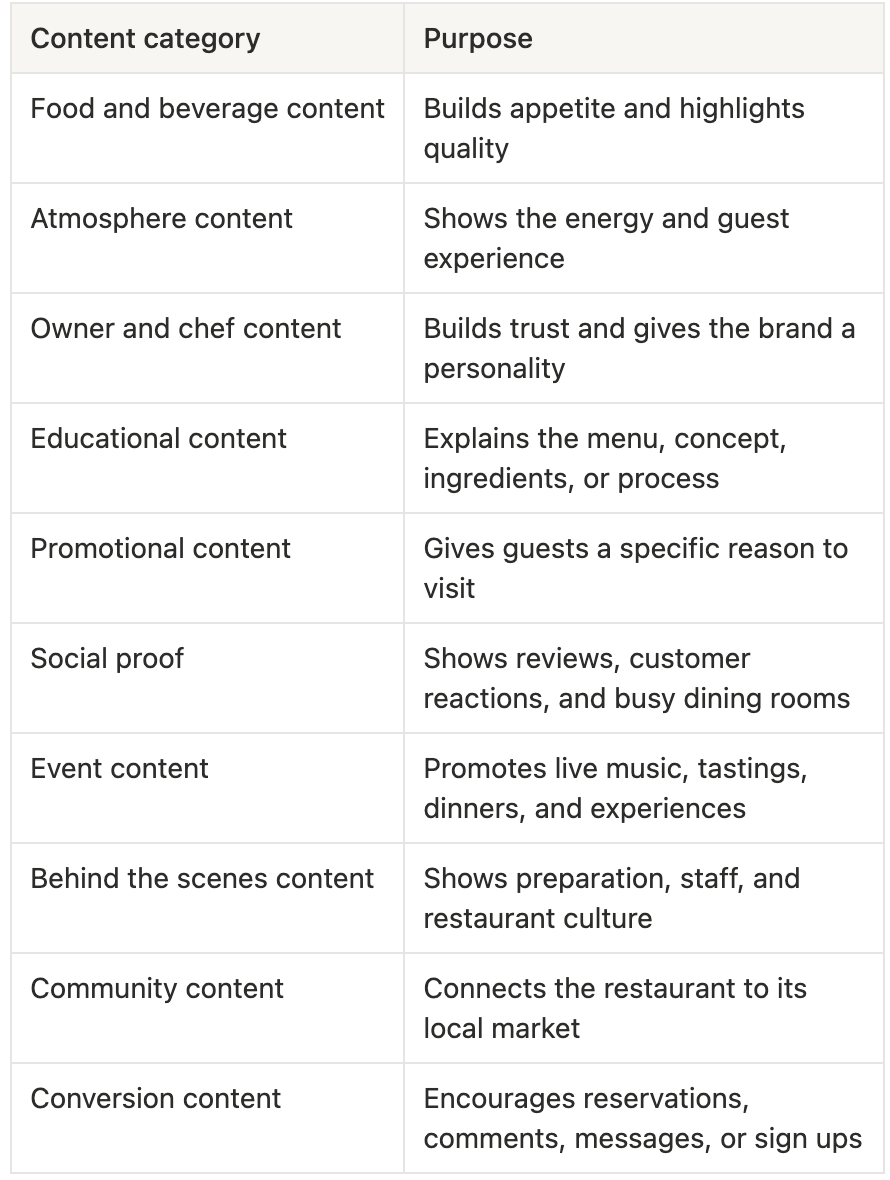
A strong content calendar uses several of these categories.
Posting only food photos makes the restaurant feel one dimensional. Guests also need to understand the people, atmosphere, story, and experience behind the food.
4. We Build a Repeatable Weekly Content System
Restaurant teams are busy. A social media plan must be easy to execute consistently.
Brand To Table builds a repeatable system that defines:
- What gets filmed
- Who needs to be on camera
- Which promotions need graphics
- When content gets posted
- Which offers require paid advertising
- What call to action should be used
- Who responds to comments and messages
- How leads are followed up with
A typical restaurant content schedule may include:
- One owner, chef, or manager video
- One food focused video
- One atmosphere or guest experience video
- One promotional post
- Daily Stories
- Review or customer generated content
- Direct promotion of an event, offer, or reservation opportunity
The exact schedule depends on the restaurant.
The goal is not to post as often as possible. The goal is to create enough quality content to stay visible, build trust, and give customers reasons to take action.
5. We Give Every Post a Clear Job
Every restaurant post should have a purpose.
A post may be designed to:
- Reach new local customers
- Educate people about the concept
- Build trust in the owner or chef
- Promote a menu item
- Drive reservations
- Generate comments
- Sell event tickets
- Grow an email list
- Start a direct message conversation
- Bring guests back during a slower period
The call to action should match that purpose.
Examples of clear restaurant calls to action include:
- Reserve your table
- Comment “BRUNCH” for the menu
- Send us a message for private event details
- Join the VIP list
- Tag the person you are bringing
- Order online
- Visit us this Wednesday
- Comment “PODCAST” for the full episode
- Save this for your next date night
“Come check us out” is usually too weak.
Customers need a clear next step.
6. We Use Direct Message Automations to Capture Demand
One of the biggest missed opportunities in restaurant social media is failing to follow up with people who engage.
A guest may comment on a brunch post, ask about an event, or show interest in a new restaurant opening. Without a system, that interest disappears.
Brand To Table uses direct message automations to turn engagement into conversations.
For example:
- A restaurant posts a video promoting its new brunch menu.
- The post asks users to comment “BRUNCH.”
- The customer automatically receives the menu or reservation link through direct message.
- The restaurant can collect an email address or phone number.
- The customer can be reminded about brunch later.
This gives the restaurant something more valuable than a like.
It creates a direct connection with a potential guest.
DM automations can support:
- Restaurant openings
- VIP lists
- Brunch menus
- Holiday reservations
- Ticketed events
- Private dining
- Catering
- Giveaways
- Loyalty programs
- Podcast episodes
- Limited menu releases
The automation must still feel human. It should help the customer get information quickly without creating a long, confusing message sequence.
7. We Connect Organic Content With Paid Advertising
Organic social media and paid advertising should work together.
Organic content builds credibility. Paid advertising helps the strongest message reach more people in the right local market.
Brand To Table does not recommend putting advertising money behind every post.
We identify campaigns that have a clear offer, target audience, timeframe, and customer action.
Examples include:
- A new restaurant grand opening
- Sunday brunch
- A ticketed wine dinner
- Weekday lunch service
- A private event campaign
- A seasonal menu
- Live entertainment
- A limited time promotion
- A restaurant hiring campaign
The content should clearly explain:
- What the offer is
- Who it is for
- Where the restaurant is located
- When the offer is available
- Why the guest should care
- What the guest should do next
A good ad cannot fix a confusing offer.
The message must be clear before the campaign launches.
8. We Plan Promotions Far Enough in Advance
Many restaurant events fail because promotion starts too late.
Posting a graphic three days before a wine dinner is not a complete marketing plan.
Brand To Table builds promotional timelines based on the type of campaign.
General Restaurant Promotion Timeline
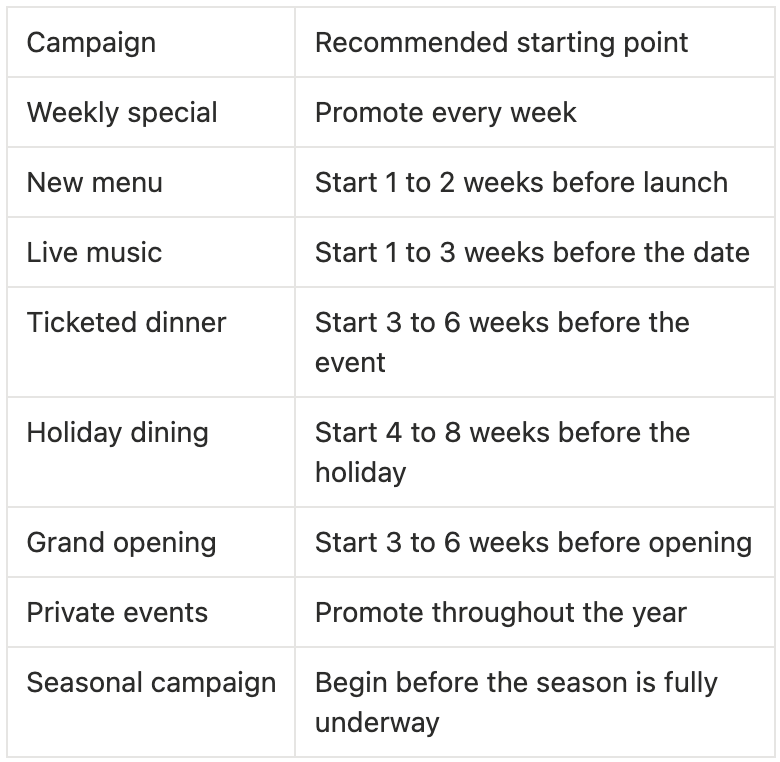
Customers need to see an offer more than once.
The first post creates awareness. Later content builds familiarity, answers questions, and gives people a reason to act.
9. We Make the Restaurant Team Part of the Strategy
Restaurant social media works better when the people inside the business participate.
The owner, chef, bartender, event manager, and front of house team each have valuable knowledge.
Brand To Table may use the team to create content about:
- The restaurant’s story
- Menu development
- Signature dishes
- Cocktail preparation
- Hospitality standards
- Private event options
- Ingredient sourcing
- Restaurant culture
- Common customer questions
- Upcoming promotions
People trust people.
A restaurant account becomes more memorable when customers recognize the faces behind the business.
This does not mean every employee needs to become a content creator. A small number of comfortable, knowledgeable team members can provide enough personality to make the brand feel human.
10. We Protect the Guest Experience
Marketing does not stop when the guest enters the restaurant.
The valet, host stand, bathroom, dining room, service team, food quality, and payment process all affect whether the customer returns.
A strong campaign may get someone through the door once. The experience determines whether the restaurant earns a repeat customer.
Brand To Table pays attention to the connection between marketing and operations because the two cannot be separated.
A restaurant cannot advertise warm hospitality while guests are ignored at the host stand. A restaurant cannot promote premium dining while the bathrooms are dirty. A restaurant cannot build loyalty if nobody responds to customer feedback.
Social media creates an expectation.
The operation must deliver on that expectation.
What Brand To Table Has Learned From Marketing NJ Restaurants
Consistency Beats Random Creativity
One strong weekly offer promoted consistently is often more effective than launching a different promotion every few days.
Customers need time to learn the offer.
When a restaurant changes its message constantly, the audience never knows what the restaurant is known for.
A Clear Offer Is Easier to Market
“Join us for a great night” is not a strong offer.
“Half price wings every Wednesday from 6 p.m. until close” is clear.
The customer knows what is available, when it is available, and why they should visit.
Restaurant Owners Should Be Visible
Owner and chef videos often create trust faster than polished food content alone.
Customers want to know who is behind the concept, why the restaurant exists, and what the team cares about.
The Dining Room Is a Content Opportunity
A busy dining room, a strong guest reaction, or a memorable hospitality moment can communicate more than a staged photo.
Restaurants should capture the experience, not only the plates.
Local Relevance Matters More Than Large Reach
A post reaching 10,000 people across the country may be less valuable than a post reaching 1,000 people within driving distance.
Restaurant marketing should prioritize qualified local attention.
Social Media Should Create an Owned Audience
Restaurants should not rely completely on Instagram or Facebook.
Email lists, text lists, loyalty programs, reservation databases, and direct message contacts give the restaurant more ways to reach customers again.
The goal is not only to gain followers. The goal is to build a customer database the restaurant can use responsibly over time.
How We Measure a Restaurant Social Media Strategy
Brand To Table looks beyond likes and follower counts.
The most useful measurements depend on the campaign.
Important restaurant marketing metrics include:
- Reservations
- Online orders
- Event ticket sales
- Private event inquiries
- Direct message conversations
- Email sign ups
- Text list growth
- Website visits
- Offer redemptions
- Repeat visits
- Reach within the target market
- Cost per lead
- Cost per reservation
- Engagement from local customers
- Revenue during the promoted daypart
Likes can show whether content caught someone’s attention. They do not automatically prove that the marketing generated business.
Clicks do not pay the bills. Covers do.
What Is Included in Brand To Table’s Restaurant Social Media Strategy?
The exact services depend on the restaurant, number of locations, and business goals.
A Brand To Table social media marketing strategy may include:
- Brand and marketing discovery
- Competitor research
- Audience definition
- Content planning
- Social media management
- Video production
- Food photography
- Graphic design
- Promotional campaign development
- Email marketing
- SMS marketing
- Direct message automations
- Influencer and creator campaigns
- Meta advertising
- Google advertising
- Review response strategy
- Menu and print design
- Landing pages
- Restaurant website support
- Monthly reporting
- Ongoing marketing leadership
For multi location groups, Brand To Table can also create a shared strategy while preserving the identity and local priorities of each concept.
Who Is Brand To Table’s Social Media Strategy Best For?
Brand To Table is a strong fit for:
- Independent New Jersey restaurants
- Multi location restaurant groups
- Hospitality companies
- New restaurant openings
- Restaurants with inconsistent social media
- Owners who need marketing leadership
- Restaurants trying to increase midweek traffic
- Restaurants building private event revenue
- Concepts that need better video content
- Restaurants that want to connect social media with email, SMS, and direct messages
Brand To Table is not built around posting generic content for the sake of filling a calendar.
The process works best when the restaurant is willing to share business goals, coordinate upcoming promotions, participate in content production, and improve the guest experience when needed.
Frequently Asked Questions
How often should a restaurant post on social media?
Most restaurants should publish three to five strong feed posts per week and use Stories consistently. The right schedule depends on the restaurant’s promotions, content quality, audience, and ability to respond to engagement.
Which social media platform is best for NJ restaurants?
Instagram and Facebook remain important for most restaurant brands. TikTok can help restaurants reach new audiences through short form video. The best platform depends on the restaurant’s target customer and the type of content the team can produce consistently.
Does every restaurant need professional video?
Restaurants do not need every video to look like a commercial. They do need clear, well planned content that makes the food, people, and atmosphere feel appealing. A mix of professional production and natural phone content often works well.
How long does it take for a restaurant social media strategy to work?
Some promotions can generate activity quickly. Building a recognizable local brand takes consistent execution over several months. Restaurants should evaluate both immediate campaign results and longer term growth in awareness, customer data, and repeat visits.
Can social media help a restaurant’s slower nights?
Yes. Social media can support slower nights when the restaurant has a clear offer, consistent promotion, local targeting, and an experience worth visiting. Marketing alone cannot fix weak service, poor food quality, or an offer customers do not want.
Should every restaurant promotion include a discount?
No. Discounts can help create urgency, but restaurants can also market experiences, limited menus, entertainment, convenience, exclusivity, or atmosphere. The offer must give customers a clear reason to visit.
What is the difference between a content calendar and a social media strategy?
A content calendar shows what will be posted and when. A social media strategy explains why the content is being created, who it should reach, what action it should produce, and how success will be measured.
Can Brand To Table manage social media for multiple restaurant locations?
Yes. Brand To Table works with independent restaurants, multi location operators, and hospitality groups. Each location can have its own priorities while still following a clear group marketing strategy.
Does Brand To Table only work with restaurants in New Jersey?
Brand To Table specializes in restaurant and hospitality marketing, with deep experience in the New Jersey market. The agency can also support restaurant groups and hospitality brands outside New Jersey when the partnership is a strong fit.
How does Brand To Table turn social media engagement into customers?
Brand To Table connects content to clear actions such as reservations, direct messages, email sign ups, text list growth, event tickets, online orders, and private event inquiries. The goal is to move the customer from watching content to taking the next step.
Build a Restaurant Social Media Strategy That Supports the Business
Restaurant social media should not operate separately from the rest of the business.
The strongest strategies connect content, promotions, paid advertising, customer data, guest experience, and follow up.
That is how Brand To Table approaches restaurant marketing.
We learn what the restaurant needs, build a practical plan, create the right content, and connect that content to actions that can support revenue.
For New Jersey restaurant owners and hospitality groups that need more than random posting, Brand To Table provides the marketing leadership and execution needed to build a stronger local brand.
Explore Brand To Table’s restaurant marketing, branding, content, advertising, email, automation, and consulting services at BrandToTable.com.
Need Help? Click Here To Book a Call!

See Related Blog Posts
Insights, Ideas, and Marketing Inspiration for your restaurant.
.avif)
.jpeg)
.jpeg)