.jpeg)
Brand To Table helps New Jersey restaurants use social media storytelling to turn everyday restaurant moments into content that builds awareness, creates demand, and gives people a reason to visit.
That means we don’t simply show up, film a bunch of food, throw trending music behind it, and call it restaurant marketing.
We look for the story behind the restaurant.
Why should somebody care about this dish?
Why should they choose your restaurant Friday night?
What makes your chef different?
What does it feel like when your bar is packed during a football game?
Why does somebody drive 30 minutes to celebrate their anniversary at your restaurant instead of going somewhere closer?
Those are the stories we want to tell.
At Brand To Table, our goal is simple: stop selling dishes and start selling moments.
For restaurants in New Jersey, where customers have thousands of choices within a relatively small radius, that difference matters.
What Is Storytelling in Restaurant Social Media Marketing?
Restaurant storytelling is the process of creating social media content around the people, experiences, emotions, and reasons behind a restaurant instead of only showing its products.
A food video shows a burger.
A story explains why that burger is the one people come back for every week.
A photo shows a dining room.
A story helps somebody imagine celebrating a birthday there.
A video shows a bartender pouring a cocktail.
A story makes you want to grab your friends and meet there after work.
Storytelling does not mean every Instagram Reel needs a dramatic script.
Most great restaurant stories are actually very simple.
They might include:
- A chef explaining why a dish was created
- A customer favorite being prepared from start to finish
- A packed dining room during a big game
- A bartender introducing a seasonal cocktail
- A server sharing their favorite menu item
- Behind the scenes preparation before dinner service
- A family celebrating an important occasion
- The owner explaining why the restaurant exists
- A weekly promotion tied to a specific reason to visit
The content still looks natural.
The difference is that there is a reason behind it.
Why Food Videos Alone Are Not Enough
One of the biggest problems I see with restaurant social media is that restaurants film food simply because the food looks good.
Good looking food helps.
But there are thousands of beautiful food videos posted every single day.
Your customer is scrolling past steaks, burgers, pasta, sushi, cocktails, pizza, tacos, and desserts nonstop.
Pretty food by itself is no longer enough to separate your restaurant.
The customer needs context.
Instead of simply showing a plate of pasta, we might build the content around:
"The pasta special our chef says he could eat every day."
Instead of another beer pouring video:
"Where North Jersey goes when football Sunday gets serious."
Instead of showing an empty waterfront patio:
"Your next anniversary dinner could look like this."
The food or restaurant may be exactly the same.
The story changes how somebody sees it.
That is the difference between documenting your restaurant and marketing your restaurant.
Brand To Table Plans Content Around Customer Decisions
Before we create restaurant content, I want to understand what we are trying to make the customer do.
Are we trying to increase Monday traffic?
Fill brunch reservations?
Introduce a new menu item?
Promote happy hour?
Create awareness around private events?
Sell more during football season?
Bring customers back during a slower month?
That decision affects the story we tell.
This is important because social media content should connect to what is happening inside the restaurant.
A restaurant does not need random content.
It needs content that supports the business.
A Simple Example
Imagine a restaurant struggling with Tuesday night traffic.
The easy approach is to post:
"Come visit us Tuesday!"
The storytelling approach asks why Tuesday is worth leaving the house for.
Maybe the restaurant has:
- Half priced wings
- Live music
- Trivia
- Margarita specials
- A chef special available only that evening
Now we have something to build around.
Instead of advertising Tuesday, we are creating a reason to care about Tuesday.
That distinction shapes almost everything we do at Brand To Table.
We Look for Stories Already Happening Inside the Restaurant
Restaurant owners sometimes think they do not have enough content.
Usually, the opposite is true.
Most restaurants have dozens of stories happening every week. Nobody is capturing them strategically.
A typical restaurant gives us opportunities around:
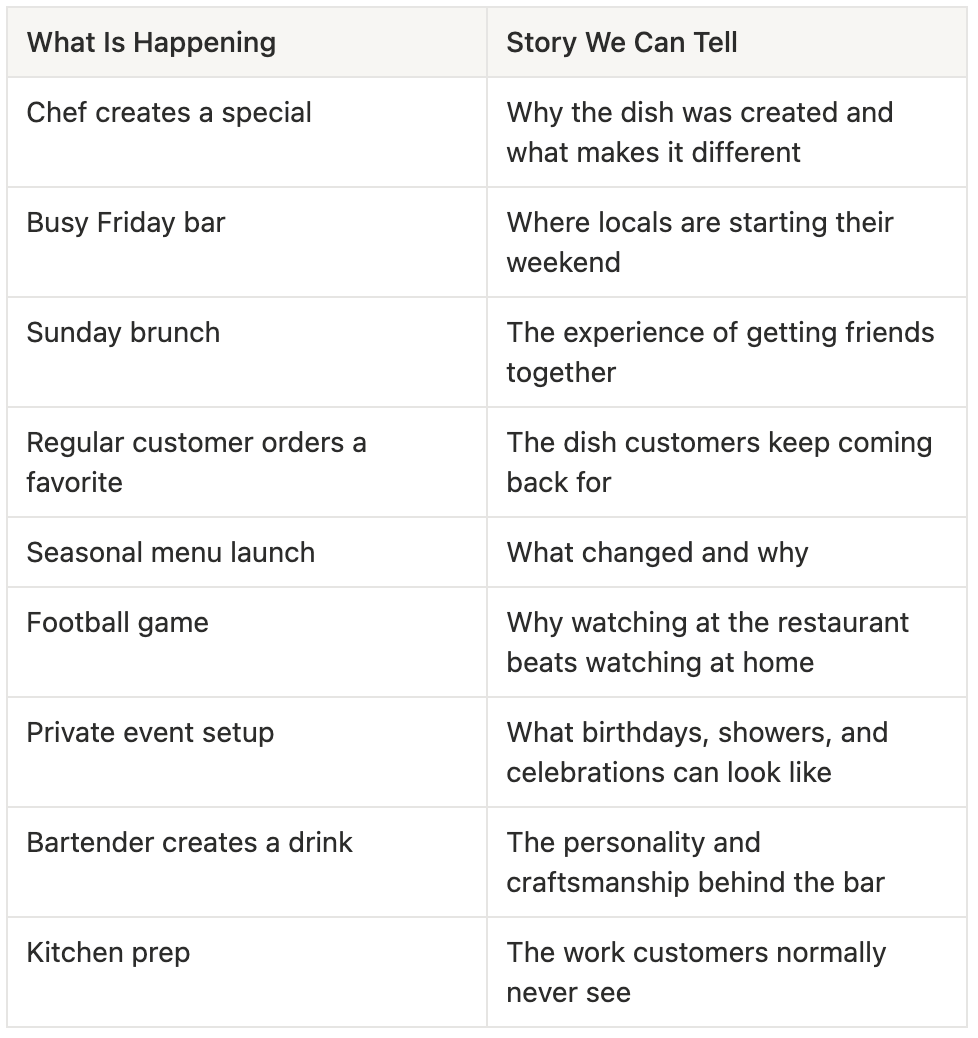
This is one of the biggest lessons I have learned working with restaurants.
You usually do not need to manufacture more things to talk about. You need to recognize the marketing opportunities already happening around you.
We Put People Back Into Restaurant Marketing
Restaurants are hospitality businesses.
Hospitality is delivered by people.
That is why some of the strongest restaurant content features chefs, owners, bartenders, servers, managers, customers, and the personalities behind the brand.
People want to know who they are supporting.
They want to recognize the chef.
They want to know the bartender.
They want to understand the personality of the restaurant before they walk through the door.
This becomes even more important for independent New Jersey restaurants competing against large restaurant chains.
A national chain may have a much larger advertising budget.
What they usually cannot copy is your people, your history, your regular customers, your personality, and your connection to the local community.
That is your advantage.
Brand To Table tries to make that advantage visible.
We Create Content Around Moments People Want to Experience
The most effective restaurant content often makes the viewer think one thing:
"I want to be there."
That is very different from:
"That looks nice."
Consider the difference.
A close up video of cocktails may get attention.
A video of four friends laughing around a table while those cocktails arrive creates a scene somebody can picture themselves in.
A steak looks delicious.
A steak arriving at the table during an anniversary dinner tells a bigger story.
A waterfront restaurant looks beautiful.
Showing sunset, drinks hitting the table, people laughing, boats passing, and dinner being served turns the location into an experience.
Restaurants sell food.
But customers frequently make dining decisions based on the experience surrounding the food.
Our content needs to communicate both.
Storytelling Is Especially Important for New Jersey Restaurants
New Jersey restaurant customers have a huge number of choices.
In many parts of North Jersey, somebody can reach dozens of restaurants within a short drive.
That creates a different marketing problem.
Your competition is not only another Italian restaurant, steakhouse, sports bar, or waterfront restaurant.
You are competing with every reasonable option for that customer's time and money.
That is why simply saying:
"We have great food."
does not mean much.
Almost every restaurant says it has great food.
A stronger restaurant brand answers more specific questions:
- What kind of night will I have here?
- Who normally comes here?
- What should I order?
- What makes this place different?
- Is it worth the drive?
- Can I bring my kids?
- Is this good for date night?
- Will the bar be fun during the game?
- Can I celebrate an anniversary here?
- Why should I choose this place instead of the restaurant down the street?
Good storytelling answers those questions before the customer ever makes a reservation.
How Brand To Table Builds a Restaurant Social Media Story
Our approach generally comes down to four parts.
1. Start With the Business Goal
We identify what the restaurant needs to promote or improve.
That could be brunch, happy hour, events, slower weekdays, seasonal offers, catering, private dining, or simply stronger local awareness.
2. Find the Human Angle
We look for the person, moment, emotion, opinion, or experience that makes the content interesting.
Instead of:
"Here is our new special."
We might ask the chef why they created it.
3. Show Proof
The content should help people believe the story.
Show the kitchen.
Show the crowd.
Show the ingredients.
Show the dining room.
Show the chef.
Show customers enjoying themselves.
The restaurant itself becomes the proof.
4. Give People a Next Step
Restaurant marketing should eventually lead somewhere.
That could mean:
- Book a reservation
- Visit this weekend
- Come in for happy hour
- Order the featured dish
- Comment for more information
- Join an email or SMS list
- Attend an event
- Call about a private party
Not every social media post needs a hard sales pitch.
But the overall content strategy should support customer action.
Multi Location Restaurants Need Consistency Without Becoming Boring
Storytelling becomes even more important when a restaurant has multiple locations.
The brand needs to feel consistent.
But each location may have different customers, personalities, events, traffic patterns, and local communities.
The solution is not to publish the exact same content everywhere without thinking about it.
Brand To Table looks at the overall brand first and then identifies opportunities within individual locations.
For example, one location may need stronger college football content while another location may respond better to family dining or happy hour messaging.
The restaurant still feels like the same brand.
The story becomes more relevant to the customer seeing it.
What We Have Learned From Creating Restaurant Content Every Week
Working inside restaurant marketing week after week has made a few things very clear.
The best looking video is not always the best marketing video.
Sometimes a simple video with a great idea will outperform a polished video that has nothing meaningful to say.
Offers need stories too.
Posting a graphic that says "$10 Margarita Night" tells people the price.
Showing what Margarita Night actually feels like gives them a reason to come.
Customers care about people.
Chefs, owners, bartenders, managers, and servers can become part of the brand when restaurants are willing to put them in front of the camera.
Content gets stronger when it is connected to the restaurant calendar.
When we know what needs to happen three weeks from now, we can create content today that helps build demand for it.
And most importantly:
Social media should never exist in its own little marketing bubble.
It should connect to reservations, events, promotions, email marketing, SMS, loyalty programs, operations, and what is actually happening inside the restaurant.
That is how Brand To Table approaches restaurant marketing.
Restaurant Storytelling Is Not About Going Viral
Restaurant owners often ask about getting more views.
Views are useful.
Reach is useful.
Followers can be useful.
But none of those numbers automatically equal restaurant revenue.
A Reel with 100,000 views from people living across the country may be less valuable than a Reel seen by 5,000 people who live 15 minutes from your restaurant.
The goal is not simply attention.
The goal is relevant local attention that can eventually become a visit.
That is why Brand To Table focuses on telling the right story to the right customer instead of chasing every social media trend.
Frequently Asked Questions About Restaurant Storytelling
What is storytelling in restaurant marketing?
Restaurant storytelling uses people, experiences, emotions, history, preparation, and customer moments to explain why someone should care about a restaurant. It goes beyond simply showing menu items.
Does every restaurant social media post need to tell a story?
Not every post needs a complicated narrative. Even a short Reel can tell a story by giving the viewer context around a dish, person, event, promotion, or experience.
What type of restaurant stories perform well on social media?
Chef stories, behind the scenes content, customer favorites, restaurant experiences, events, staff personalities, seasonal dishes, celebrations, and local community content are strong starting points.
Is restaurant storytelling only for Instagram?
No. The same storytelling strategy can support Instagram, Facebook, TikTok, YouTube Shorts, email marketing, SMS, websites, advertising, and other restaurant marketing channels.
How often should a restaurant post on social media?
There is no perfect number for every restaurant. Consistency matters more than chasing a specific posting frequency. The content should support the restaurant's promotions, events, customer behavior, and business goals.
Can storytelling help a restaurant increase reservations?
Storytelling can help customers understand what they can expect from a restaurant and give them a stronger reason to visit. The content should then make it easy for interested customers to reserve, call, order, or take another clear next step.
How does Brand To Table create restaurant social media content?
Brand To Table starts with the restaurant's business goals, identifies the strongest stories happening inside the brand, develops the content angles, creates the content, and connects those stories to promotions and customer actions.
Does Brand To Table work with multi location restaurants?
Yes. Multi location restaurant marketing requires maintaining a consistent brand while creating content that can still speak to the customers, promotions, and opportunities surrounding individual locations.
Why does local storytelling matter for New Jersey restaurants?
New Jersey diners have a large number of restaurant options within relatively short driving distances. Local storytelling helps a restaurant communicate why its experience, people, atmosphere, food, and personality are worth choosing over nearby alternatives.
Your Restaurant Probably Has More Stories Than You Think
You do not need to turn your restaurant into a Hollywood production studio.
You need to get clearer about what makes people care.
Your chef has stories.
Your staff has stories.
Your regular customers have stories.
Your menu has stories.
Your events have stories.
Your dining room has stories.
The job of restaurant marketing is to recognize those moments, package them correctly, and put them in front of the right people.
That is what we help restaurants do at Brand To Table.
We build marketing around what is actually happening inside the restaurant and connect the content back to the goals that matter to the business.
Because getting views is nice.
Getting somebody to say "We need to go there" is better.
If your New Jersey restaurant or hospitality group needs a stronger social media strategy, better storytelling, or a marketing plan that connects content to actual business goals, explore Brand To Table and see how we help restaurant brands turn what makes them different into marketing people actually care about.

See Related Blog Posts
Insights, Ideas, and Marketing Inspiration for your restaurant.

.avif)