How New Jersey Restaurants Should Decide Where to Spend Their Marketing Budget
The best way for a New Jersey restaurant to decide where to spend its marketing budget is to start with a specific business problem, identify the revenue opportunity behind it, and then choose the marketing campaign and channels most likely to produce that result.
At Brand To Table, we do not start by asking, “What should we post this month?”
We start by asking:
- Which days are slow?
- Which dayparts need more traffic?
- Are private event inquiries down?
- Is lunch underperforming?
- Do more people need to know about a new location?
- Do we need new customers or more visits from existing customers?
- Is there an upcoming event that needs ticket sales or reservations?
- Which revenue opportunity would have the biggest impact on the business right now?
Once we know the problem, we can decide where the restaurant should spend its marketing dollars.
That is very different from randomly boosting posts, running ads, hiring influencers, or increasing content just because everyone says a restaurant needs to “do more marketing.”
The goal is not to spend more.
The goal is to spend smarter.
Where Should New Jersey Restaurants Spend Their Marketing Budget?
A restaurant should spend its marketing budget on the campaigns that have the clearest connection to revenue, traffic, reservations, orders, leads, or repeat visits.
That could mean spending money to:
- Increase Monday through Wednesday traffic
- Grow lunch business
- Fill Sunday brunch
- Generate private event inquiries
- Sell tickets to a wine dinner
- Drive online ordering
- Launch a new restaurant location
- Build awareness in a new geographic market
- Increase repeat visits
- Grow an email or SMS database
The right answer will be different for every restaurant.
A busy Saturday night restaurant and a restaurant struggling to fill Tuesday dinner should not have the same marketing priorities.
Your restaurant marketing budget should follow the opportunity.
Restaurant Marketing Campaigns Should Start With a Revenue Goal
Before a restaurant spends money on Meta ads, Google Ads, influencers, email marketing, video production, or social media campaigns, there should be a clear business goal.
“Get more engagement” is not a strong enough goal.
Neither is “grow our Instagram.”
A stronger goal sounds like:
- Add 40 more covers on Tuesday
- Increase Sunday brunch reservations
- Generate more qualified private dining leads
- Sell 75 tickets to an upcoming event
- Increase online pizza orders on Monday nights
- Build a launch list before opening a new location
- Increase visits from existing customers
Those are business outcomes.
Once we know the outcome, we can work backward and determine which restaurant marketing campaign deserves the budget.
How Brand To Table Chooses Which Restaurant Marketing Campaigns Are Worth Paying For
When a restaurant comes to us with a marketing idea, we run it through several filters before recommending that they spend money on it.
1. What Business Problem Are We Solving?
This is always the first question.
“Business is slow” is still too broad.
Where is it slow?
When is it slow?
What part of the business needs help?
A restaurant may be packed Friday and Saturday but struggle Monday through Wednesday.
In that situation, spending a large portion of the advertising budget promoting Saturday night probably does not make much sense.
The bigger opportunity may be Tuesday.
We might create a Tuesday campaign that gives customers a reason to visit, then support it with email, social media, in restaurant promotion, and paid advertising.
The goal is to spend marketing dollars where they can create incremental business.
2. Who Are We Trying to Reach?
Not every restaurant campaign should target everyone.
A family pizza restaurant trying to increase Tuesday takeout orders has a very different target customer than an upscale restaurant promoting a $150 wine dinner.
Depending on the goal, a New Jersey restaurant may need to reach:
- Families within five miles
- Young professionals looking for happy hour
- Existing customers
- Local food creators
- Corporate event planners
- Couples looking for date night
- Sports fans
- Parents
- Local office workers
- People searching for restaurants near a specific town
- Customers who have visited before but have not returned recently
The audience influences the message, offer, creative, platform, and advertising budget.
3. Is the Offer Strong Enough to Advertise?
Advertising cannot fix a weak offer.
This is one of the most common problems we see.
A restaurant may want to spend hundreds or thousands of dollars promoting something that is not interesting enough for the customer to take action.
Before spending more money, we ask:
Why should somebody care?
A strong restaurant offer does not always mean giving a discount.
The reason to visit could be:
- A limited menu
- A chef collaboration
- Live entertainment
- A new brunch experience
- A seasonal dish
- A ticketed dinner
- A loyalty reward
- VIP access
- A giveaway
- A special event
- A unique experience
- A reason to visit during a normally slow daypart
Customers need a clear reason to act.
If that reason is weak, increasing the restaurant advertising budget usually does not solve the problem.
Not Every Restaurant Marketing Campaign Needs an Advertising Budget
Restaurants sometimes assume every promotion needs paid advertising.
It does not.
One of the first things we look at is the audience the restaurant already owns.
That can include:
- Email subscribers
- SMS subscribers
- Instagram followers
- Facebook followers
- Loyalty members
- Past event guests
- Previous online ordering customers
- Existing restaurant guests
A restaurant may be able to promote a campaign through:
- SMS
- Instagram Stories
- Instagram Reels
- Google Business Profile
- In restaurant signage
- Server communication
- Loyalty programs
- Direct message automation
If a restaurant already has thousands of past customers available through email or SMS, we may test the campaign with that audience before spending heavily to acquire new customers.
This can tell us a lot.
If the people who already know and like the restaurant are not responding to the offer, paying Meta to show it to another 20,000 people may not be the solution.
When Should Restaurants Spend Money on Meta Ads?
Meta advertising can make sense when the restaurant has a clear audience, strong creative, a compelling reason to visit, and a measurable goal.
We commonly use paid Facebook and Instagram advertising for several restaurant marketing campaigns.
Restaurant Openings
New restaurants need awareness quickly.
Paid advertising can introduce:
- The concept
- The food
- The location
- The story
- The opening date
- The people behind the restaurant
For openings, we also like to build an email or SMS list before the doors open.
That way, the restaurant advertising budget is not only buying impressions.
It is helping create an audience the restaurant can communicate with again later.
Brunch Campaigns
Paid social advertising can be useful when a restaurant is trying to establish a new brunch habit with local customers.
But the creative matters.
A static graphic saying “Sunday Brunch” usually does not sell the experience as effectively as great food and lifestyle content.
Show the food.
Show the cocktails.
Show the atmosphere.
Show people enjoying themselves.
Give customers a reason to picture themselves there this Sunday.
Ticketed Restaurant Events
Wine dinners, chef dinners, charity events, themed experiences, and other ticketed events can be strong paid marketing opportunities because the revenue goal is easy to understand.
For example:
100 tickets at $125 each creates a potential revenue opportunity of $12,500.
Now we have something concrete to work backward from.
We can decide how much marketing spend might be reasonable based on the size of that opportunity.
New Restaurant Locations
Multi location restaurant groups should not assume customers automatically know when another location opens.
Every location has its own local market.
When a restaurant opens in a new town, the marketing campaign should create awareness within the realistic geographic area where customers are likely to visit.
When Should Restaurants Spend Money on Google Ads?
Google Ads can make more sense when people are actively searching for something the restaurant sells.
Meta and Google often solve different problems.
Meta helps us put a restaurant in front of people who may not currently be thinking about it.
Google helps us reach somebody who is already looking for an answer.
That distinction matters.
Someone scrolling Instagram may not currently be thinking about booking a rehearsal dinner.
Someone searching:
“rehearsal dinner restaurant Morris County NJ”
has much stronger intent.
Google Ads may make sense for restaurant searches involving:
- Private dining
- Catering
- Restaurants near me
- Rehearsal dinners
- Birthday party venues
- Corporate events
- Waterfront dining
- Outdoor dining
- Specific cuisines
- Restaurants in a specific New Jersey town
- Private party rooms
- Group dining
The question is not whether Google Ads or Meta Ads are better for restaurants.
The better question is:
Which advertising platform matches what the customer is doing when they are most likely to buy?
Why We Often Recommend Spending Restaurant Marketing Dollars on Midweek Traffic
One of the most common patterns we see with restaurant clients is uneven demand throughout the week.
Friday might be strong.
Saturday might be packed.
Tuesday might be dead.
Those three nights should not receive the same marketing investment.
If the restaurant already has more customers than it can comfortably serve Saturday night, spending money to drive additional Saturday demand might have very little value.
Tuesday is different.
An empty table on Tuesday is perishable inventory.
Once Tuesday night passes, the restaurant can never sell that seat again.
That is why we often prioritize marketing campaigns designed to create incremental visits during slower periods.
A restaurant marketing calendar should not be based on filling four social media slots every week.
It should reflect the actual revenue needs of the business.
How Much of a Restaurant Marketing Budget Should Go Toward Discounts?
Discounts should be used carefully.
Discounting can generate traffic.
It can also destroy margin or train customers to only visit when there is a deal.
Before recommending a discount driven restaurant campaign, we ask:
- Is the restaurant already busy during this period?
- Will the offer generate additional business?
- Can the kitchen and staff execute it easily?
- How much margin are we giving away?
- Could we increase perceived value without lowering the price?
- Can the offer encourage a future visit?
- Are we attracting the type of customer we actually want back?
For example, offering a heavy discount on Saturday night when the restaurant is already full usually does not make much sense.
Creating an offer that helps fill Monday or Tuesday might.
The goal is not to generate the most transactions.
The goal is to generate profitable incremental business.
Why Restaurant Operations Should Influence the Marketing Budget
A campaign can look great on Instagram and still be terrible for the restaurant.
Marketing and operations have to work together.
If a promotion requires the host, bartender, servers, kitchen, managers, and POS system to understand complicated redemption rules, execution becomes harder.
When execution fails, the customer feels it.
Before we recommend spending restaurant marketing dollars on a promotion, we look at whether the operation can actually support it.
We ask:
- Can a server explain the promotion in one sentence?
- Does the kitchen know what is being promoted?
- Can the POS system handle it?
- Does management understand the redemption process?
- Is the call to action clear?
- Will customers understand the offer?
- Can the restaurant handle the extra demand if the campaign works?
Great marketing that creates a terrible guest experience is not great marketing.
How Much Should a Restaurant Spend on Advertising?
There is no universal restaurant advertising budget that works for every business.
At Brand To Table, we prefer to work backward from the size of the business opportunity.
Consider a restaurant promoting an event with:
- 100 available tickets
- $125 ticket price
- $12,500 potential ticket revenue
That gives us a measurable revenue opportunity.
Now compare that with spending $2,000 promoting a random menu item with:
- No tracking
- No clear audience
- No specific sales goal
- No redemption mechanism
- No way to determine whether the campaign worked
Those are very different investments.
The restaurant advertising budget should reflect the value of the opportunity and the restaurant's ability to measure the outcome.
How Should Restaurants Measure Marketing ROI?
Restaurant marketing ROI should be measured against the business result the campaign was designed to create.
Likes are useful signals.
Views can tell us whether the content is getting attention.
Reach tells us how many people saw something.
Those numbers matter, but they are usually not the final goal.
Depending on the campaign, Brand To Table may focus more heavily on:
- Reservations
- Covers
- Online orders
- Ticket sales
- Private event leads
- Email signups
- SMS signups
- Offer redemptions
- Repeat visits
- Cost per lead
- Cost per reservation
- Revenue generated
Marketing activity is not the same thing as marketing performance.
A restaurant can have a beautiful social media feed and still have a weak marketing strategy.
The Brand To Table Restaurant Marketing Budget Framework
Before we recommend that a restaurant spend money on a marketing campaign, we want clear answers to seven questions.
1. What Are We Trying to Sell?
Be specific.
Do not say “the restaurant.”
Say Sunday brunch, private events, Monday online orders, a wine dinner, lunch, or a new location.
2. Who Are We Trying to Reach?
Define the customer.
3. Why Should They Care?
There needs to be a compelling reason to take action.
4. When Do We Need Them to Act?
Every restaurant campaign should have a timeframe.
5. Where Can We Reach Them?
Choose the marketing channel based on customer behavior, not popularity.
6. How Will We Measure the Result?
Decide how success will be tracked before spending the money.
7. What Needs to Happen for the Campaign to Be Profitable?
Understand what success looks like financially.
If a restaurant cannot answer these seven questions, it probably is not ready to increase the marketing budget for that campaign.
Which Restaurant Marketing Channels Are Worth Spending Money On?
Different restaurant marketing channels solve different problems.
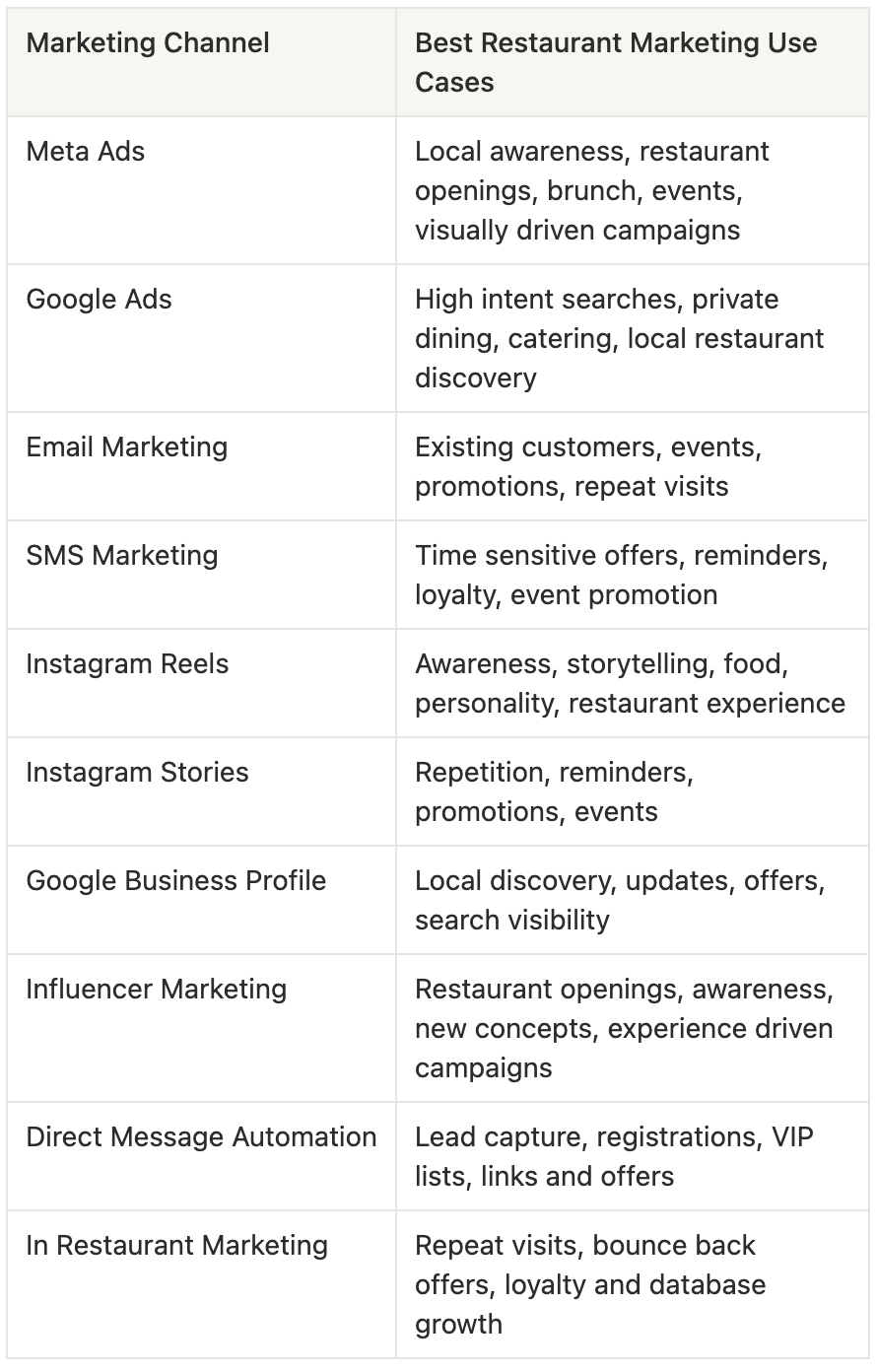
The best restaurant marketing strategy usually combines several channels around one business objective.
One Marketing Campaign Can Use Several Channels
A campaign and a marketing channel are not the same thing.
This is an important distinction.
The campaign is what the restaurant is trying to accomplish.
The channels are how we distribute the message.
For example, a restaurant promoting a wine dinner might use:
- Instagram Reels to introduce the event
- Instagram Stories for reminders
- Meta Ads to reach new local customers
- Email to reach past guests
- SMS closer to the event date
- In restaurant signage for current guests
- Direct message automation to distribute the registration link
That is one restaurant marketing campaign distributed across multiple channels.
We do not want seven disconnected marketing tactics.
We want seven tactics working together toward the same result.
What We Have Learned Helping New Jersey Restaurants Spend Their Marketing Budgets
One of the biggest lessons we have learned working directly with restaurant operators is that most restaurants do not need more random marketing activity.
They need more focus.
We regularly see restaurants trying to market everything at once.
Happy hour.
Brunch.
Private events.
Lunch.
A new menu.
Live music.
A giveaway.
A holiday.
A special cocktail.
When everything is important, nothing feels important.
We would rather identify the one or two revenue opportunities that matter most to the restaurant right now and build concentrated campaigns around them.
Restaurants Usually Underestimate Frequency
Another pattern we see is restaurants promoting something once and assuming the audience saw it.
Most people did not.
Customers are busy.
Social feeds move quickly.
Emails get missed.
Stories disappear.
A strong restaurant campaign needs repetition.
The solution is not posting the exact same graphic 15 times.
The solution is communicating the same offer through different formats.
That might include:
- A food Reel
- A talking head video
- An email
- Instagram Stories
- Customer footage
- A static graphic
- An SMS reminder
- In restaurant signage
Consistency and frequency usually matter more than constantly creating new marketing ideas.
Restaurants Often Spend Too Quickly on Customer Acquisition
Restaurants naturally want more new customers.
But sometimes there is more value sitting inside the restaurant's existing database.
If thousands of people have already eaten at your restaurant, followed you, joined your loyalty program, or subscribed to email, that audience should not be ignored.
Before spending heavily to acquire strangers, we look at whether we can generate another visit from someone who already knows the brand.
Repeat visits can be one of the most overlooked restaurant marketing opportunities.
What Makes Brand To Table's Restaurant Marketing Approach Different?
Brand To Table approaches restaurant marketing from the business backward.
We are not trying to fill a content calendar simply to prove that marketing is happening.
Content matters.
Branding matters.
Video matters.
Advertising matters.
Email matters.
Social media matters.
But none of those should exist without a reason.
We start with:
- Revenue opportunities
- Traffic patterns
- Dayparts
- Customer behavior
- Business goals
- Operational capabilities
- Current marketing assets
Then we build the restaurant marketing strategy around the desired result.
That is how we help New Jersey restaurants determine where their marketing budget should go and avoid spending money on campaigns that generate activity without generating meaningful business results.
Frequently Asked Questions About Restaurant Marketing Budgets and Campaigns
How should a New Jersey restaurant decide where to spend its marketing budget?
Start with the business problem you need to solve. Identify the revenue opportunity, determine the customer you need to reach, create a compelling reason for them to act, and then choose the marketing channels that best support that goal.
How much should a restaurant spend on marketing?
There is no universal percentage that works for every restaurant. Your restaurant marketing budget should reflect your revenue, growth goals, market, competition, campaign opportunities, and ability to track results.
What restaurant marketing campaigns are worth spending money on?
Campaigns tied to clear business outcomes are usually the best candidates. Examples include increasing slow night traffic, growing brunch, generating private event leads, increasing online orders, launching a new location, selling event tickets, and increasing repeat visits.
Where should restaurants spend their advertising budget?
It depends on customer intent. Meta Ads can work well for awareness and visually driven promotions. Google Ads can work well when customers are actively searching for restaurants, private dining, catering, events, or a particular cuisine.
Should restaurants spend money boosting Instagram posts?
Sometimes, but randomly boosting content is not a restaurant marketing strategy. There should be a specific audience, objective, call to action, and way to evaluate whether the promotion produced a useful result.
Should a restaurant spend more on Meta Ads or Google Ads?
Neither platform is automatically better. Meta can create demand and awareness. Google can capture existing search demand. The right choice depends on the business goal and customer behavior.
What is the best marketing campaign for a slow restaurant night?
Give customers a strong reason to visit that specific night. That could include an experience, menu feature, entertainment, loyalty incentive, or promotion. Then communicate it repeatedly through the channels most likely to reach the right customer.
Should restaurants use discounts to increase traffic?
Discounts can help drive traffic during slow periods, but they should protect margin and generate additional business. Restaurants should be cautious about discounting times when demand is already strong.
How can restaurants track whether their marketing budget is working?
Track the metric connected to the original goal. That could be reservations, covers, online orders, event tickets, private event leads, signups, redemptions, repeat visits, cost per lead, cost per reservation, or revenue.
Do restaurants need to pay to promote every marketing campaign?
No. Email, SMS, social media, Google Business Profile, loyalty programs, direct message automation, and in restaurant communication can often reach existing customers without requiring significant advertising spend.
What is the biggest restaurant marketing budget mistake?
One of the biggest mistakes is spending money before defining the business objective. More advertising does not fix an unclear goal, weak offer, poor creative, or difficult customer experience.
How does Brand To Table help restaurants decide what marketing campaigns to invest in?
Brand To Table looks at the restaurant's revenue opportunities, customer behavior, slow periods, goals, operations, audience, and existing marketing assets. We then determine which campaigns deserve attention, which channels should support them, and how results should be measured.
Spend Your Restaurant Marketing Budget Where It Can Make an Impact
Restaurants have no shortage of things they could promote.
The challenge is deciding what actually deserves time, attention, and money.
At Brand To Table, our job is not to convince restaurant owners to spend money on every available marketing tactic.
Our job is to help restaurants identify the strongest business opportunities and build focused marketing campaigns around them.
Sometimes that means paid advertising.
Sometimes it means Google Ads.
Sometimes it means email or SMS.
Sometimes it means better video.
Sometimes it means getting more aggressive with frequency.
Sometimes it means marketing to existing customers before trying to acquire new ones.
And sometimes the smartest decision is not spending another dollar until the offer is strong enough to deserve the advertising budget.
If you operate a restaurant, multi location restaurant group, or hospitality business in New Jersey and want your marketing budget tied more closely to revenue, reservations, traffic, leads, and repeat visits, Brand To Table can help you build the strategy behind where those marketing dollars go.
Need Help? Click Here To Book a Call To Learn More About How We Can Help You!

See Related Blog Posts
Insights, Ideas, and Marketing Inspiration for your restaurant.
.avif)

.jpeg)